


Hiring an experienced welder has become one of the biggest challenges in industry today. There is a lack of candidates with appropriate qualifications, and the profession itself is in the top tier of the most deficit professions. Turnover? High. In many companies, a newly hired specialist disappears after a few months because someone else offered him a better rate. And so it goes in circles. The effect? For manufacturing companies, this means something more than just a shortage of hands for work (especially those welding using the TIG method). These are delays in projects, higher order fulfillment costs and increasing pressure on the recruitment department. In extreme cases – the necessity of bringing in workers from abroad.
In response to this reality, companies are beginning to ask themselves: can the welding process be organized to be less dependent on hard-to-find specialists? This is where laser welding technology comes in. Machines that are able to significantly simplify the process operation itself – to the point that an operator can be trained in one day, not months. And importantly: someone with years of welding experience is not always needed. Will the ease of operation of laser welders allow the use of less qualified and cheaper workers?
Industry context: shortage of welders and staff turnover
If you've tried to hire a good welder in recent years, you know well that it's not a matter of posting an ad and a few recruitment interviews. They simply don't exist on the market. And those who are there – know they can pick and choose from offers.
According to the Occupations Barometer 2023, in as many as 304 out of 380 districts in Poland, the welder profession is on the list of deficit professions. So it's not about a temporary shortage of workers, but about a systemic problem that deepens year by year. And not only in Poland – throughout the European Union, welders are today among the ten most sought-after specialists.
What does this result from?
First: the generational gap. Experienced welders are retiring, and young people are not coming in at a pace to replace them. In vocational education, it's hard to find classes that train in this direction today, and even harder – young people who want to work in difficult conditions and under quality pressure.
Second: foreign departures. Many experienced workers go to Germany, Norway or the Netherlands, where the offered rates are tens of percent higher than in Poland. For companies that have contracts to fulfill here and now, this is a real problem – they have no one to fill the positions.
Third: working conditions and turnover. Welding is a demanding profession – physically and mentally. Heat, smoke, sparks, forced positions, responsibility for construction quality. No wonder welders often change employers. Sometimes because they find better conditions. Sometimes – they simply quit the profession.
In practice, this means one thing: even if you manage to find a welder today, you have no guarantee that he will stay with you for long. All this affects not only the difficulty in filling positions, but also the rising costs of employment. Companies must compete not only with rates, but also with bonuses, premiums, relocation packages, accommodation. In some cases, people are brought in from abroad – from India, Nepal, Bangladesh or Colombia – which involves additional formalities and brokerage costs.
So there's no doubt: a system based solely on "hunting for a welder with qualifications" is ceasing to work. More and more companies are starting to look for alternatives – those that will allow them to become independent from a narrow group of specialists. One of them is precisely laser welding technology.
Discover the advantages of laser welding, which are revolutionizing modern production processes.
Traditional welding vs laser welding – comparison of work nature
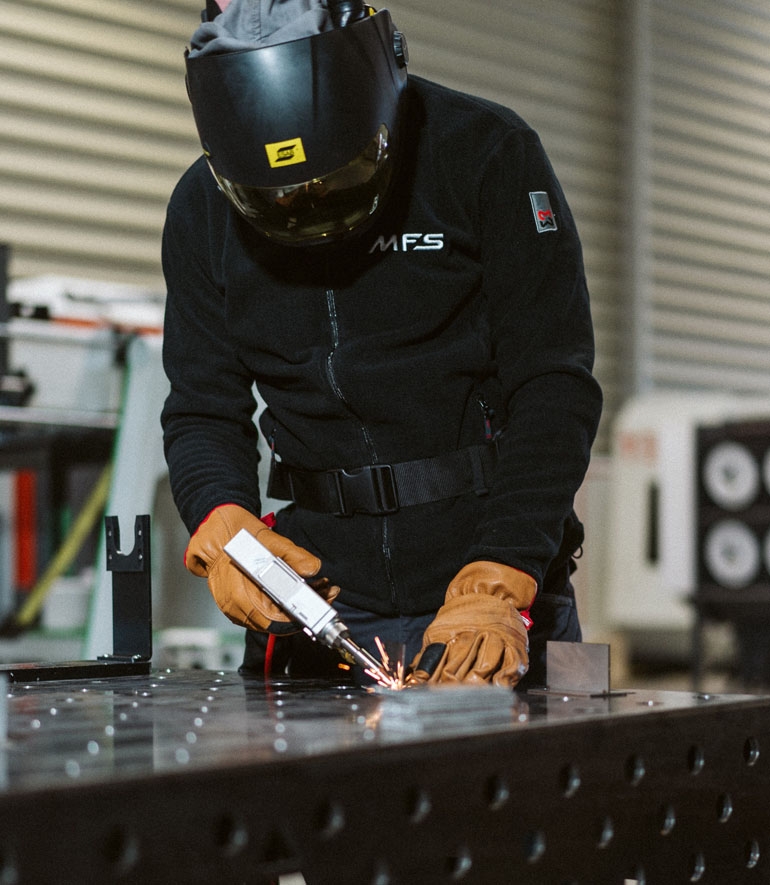
If you have traditional welders in your company, you know what their day looks like: manual arc guidance, heavy equipment, often working in a forced position, heat, smoke and concentration required every second of work. Welding using MIG/MAG or TIG method is a task that requires not only qualifications, but also real manual skills. A small error in hand positioning and we already have a problem – leakage, overlap, weld spillage, material deformation.
An experienced welder doesn't just guide the handle – he reads drawings, adjusts parameters to the type of material, takes care of joint preparation, evaluates quality on an ongoing basis. It's a profession you can't learn in two weeks.
Now compare this with the work of a laser welder operator:
Here most of the work is done using the control panel. The operator sets parameters on the screen, calibrates equipment, ensures proper element positioning and supervises the process. He may hold the head in his hand, but doesn't need the same precision as a traditional welder – because the laser beam does the job for him. There's no arc, no spatter, no need to guide the electrode with millimeter accuracy.
What's more: some laser devices are automated – after programming parameters, the machine itself guides the weld according to the established pattern. The human's role is then reduced to supervision and possible correction.
Metal welding using laser offers wide applications - from stainless steel to aluminum, and even copper. High device power allows for obtaining durable high-quality welds, which is crucial in modern production.
Precise laser welding thanks to latest generation devices allows achieving results impossible to obtain with traditional methods, especially in the case of delicate materials and complex constructions.
The effect? You can implement someone who has never held a MIG or TIG handle, but knows the basics of CNC machine operation. And doesn't need to complete a month-long welder course.
This doesn't mean that everyone can handle a laser "right away" – responsibility, precision and the ability to observe the process are still needed. But the entry threshold is lower. And this is exactly what makes companies start looking at laser welders as a tool that's not only technological, but also personnel-related: they allow production to become independent from constant rotations at the welder position.
For many plants, this could be the first step to start replacing difficult-to-fill welding positions — with a new, easier work model.
Requirements for traditional welders
Hiring a traditional welder is not just a matter of finding the right person – it's primarily meeting specific formal, technical and organizational requirements.
Let's start with what's obvious but often overlooked: you simply cannot hire someone "for welding" without qualifications. In Poland, every person performing welding work must have valid qualifications confirmed by examination – in accordance with the PN-EN ISO 9606-1 standard. We're talking about documents issued by certifying bodies, not weekend courses ending with a "participation diploma".
What's more, certificates are valid only for a specified time and must be renewed. An employee who hasn't performed a given type of weld for several months may lose the validity of their qualifications. This means one thing for the employer: the necessity of monitoring documentation, renewing training and controlling the currency of papers.
But the "papers" themselves aren't everything. Employers look for welders who:
-
have several years of experience,
-
can weld in different positions (e.g., overhead or vertical),
-
know technical drawings,
-
know how to select parameters for specific material and thickness,
-
can independently assess weld quality and correct it without supervision.
Physical requirements are added to this. A welder must have good coordination, endurance and eyesight. He works at high temperature, often in a forced position, in full protective equipment. Any vision defect, inner ear problems or limited hand mobility can exclude from the profession.
And one more thing: ability to work under stress. In welding, mistakes cost – from element rejection by quality control, to serious consequences if the defect is detected after assembly. That's why many companies require welders not only technical competence, but also composure and responsibility.
In short: a good welder is someone who not only can "make a weld", but who understands the technological process and works so that they don't need to be watched. Except there are fewer and fewer such people on the market.
Requirements for laser welder operators
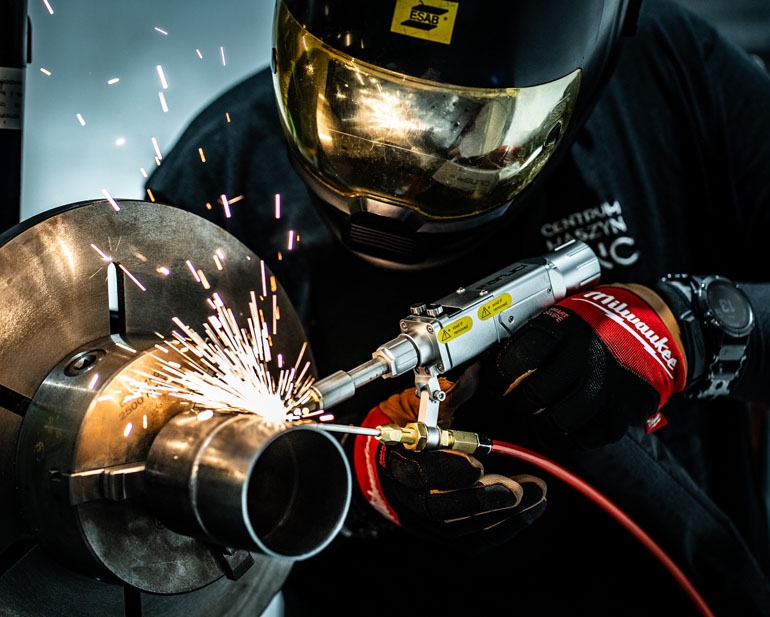
If a traditional welder is a specialist with qualifications, practice and experience gained over years, then a laser welder operator is a completely different employee profile. Here what counts above all is the ability to quickly absorb new technologies, operate the control panel and basic orientation in the welding process – without the need to guide the arc by hand.
What does this mean in practice?
First: formally, traditional welding qualifications are not always required if the operator doesn't perform manual arc welding welds, but operates semi-automatic or robotic equipment. According to the PN-EN ISO 14732 standard, the welding machine operator should, however, undergo workplace training and know the basics of the process he supervises. This training is often conducted by the machine manufacturer or an external training unit.
Second: lower entry threshold. To operate a laser welder, you can hire someone with technical education, e.g., after vocational secondary school or technical school – without years of welding experience. What counts is whether they can operate a computer, understand technical instructions, remember procedures and... not be afraid of technology.
What else do employers expect?
-
knowledge of CNC machine or production equipment operation,
-
ability to set work parameters (laser power, speed, focal length),
-
ability to monitor weld quality and report deviations,
-
accuracy and predictability in action – because laser doesn't forgive setting errors,
-
knowledge of OHS basics when working with laser radiation (e.g., mandatory protective glasses, work area closure).
In many companies, laser welder operators are recruited from internal production departments – people who previously worked e.g., at sheet cutting or bending machines, can start independent work at the laser after training.
This doesn't mean everyone is suitable. But you need less experience, fewer formal qualifications, less implementation time, and this can be decisive in the context of high employee turnover.
Read: Comprehensive guide to laser welders - learn everything you need to know about choosing the right device for your company.
Essential skills and competencies
Traditional welder skills
A good welder is not just someone who can connect two pieces of metal. It's a professional who understands the process from A to Z – from material preparation, through parameter selection, to visual weld assessment and possible corrections. What does this mean in practice?
In daily work, a welder must:
-
be able to work with MIG/MAG, TIG or electrode method (usually in several of these techniques),
-
read technical drawings and understand tolerances,
-
select welding parameters for material, thickness and weld position,
-
control weld quality during work and after its completion,
-
know OHS rules – not only general ones, but also specific to welding (e.g., workstation ventilation, eye and skin protection, fire protection).
Besides technical knowledge, practice also counts – e.g., sensing handle distance, appropriate electrode movement pace or torch guidance angle. These are things you can't learn from instructions. You need to "weld them out" – on hundreds of meters of welds.
Good welders often work "by feel", but this feel is precisely the result of years of experience. And this is what the market lacks most today.
Laser welder operator skills
In the case of a laser welder operator, the skill set looks completely different. Here, the ability to operate technology is more important than experience working with metal.
What should an operator be able to do?
-
set machine work parameters – e.g., laser power, focal length, welding speed,
-
operate the control panel or computer interface (sometimes touch, sometimes PC),
-
recognize machine operation errors and call service or correct settings,
-
control weld quality – not visually, like a welder, but based on signals from the machine and documentation,
-
work according to workplace instructions and quality procedures.
The ability for logical thinking and acting according to a scheme is also important. Working with a laser is no field for improvisation – precision, repeatability and reacting to system alarms count, not "own methods".
It's precisely this difference that makes operators easier to train and implement. They don't need to have welding experience, just technical competence and readiness to work with a machine. For companies, this means more candidates for training, fewer formalities and shorter waiting time for full employee productivity.
Employment costs and wages
Traditional welder employment costs
Hiring an experienced welder today is not only an expense, but also an investment burdened with risk. Rates? In Poland, they increasingly exceed 8–10 thousand PLN gross per month for a specialist with experience and current qualifications. In industrial regions – e.g., in Silesia or Greater Poland – offers exceeding even 12 thousand PLN gross appear.
Added to this are:
-
certification and training costs – from several hundred to several thousand zloty annually, depending on technology and number of renewed qualifications,
-
clothing and protective equipment – specialized gloves, helmets with automatic dimming, flame-retardant aprons,
-
implementation time and technological tests – before an employee is admitted to serial production, he must pass tests, qualifications and usually perform trial welds that undergo non-destructive testing.
And if the employee leaves after three months? The company bears these costs anew. And starts the entire recruitment and training process from the beginning.
Laser welder - employment costs
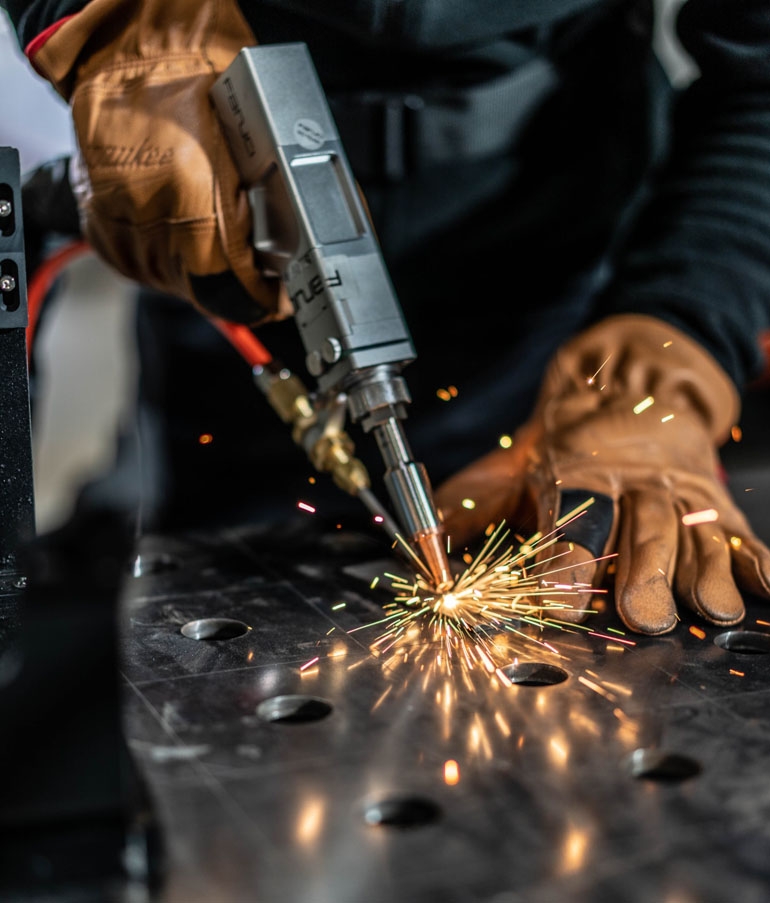
In the case of a laser welder operator, the entry cost is different – somewhat higher at the beginning, but much lower over a longer period. Laser operation training usually lasts several days and is often conducted by the machine supplier as part of implementation. On the company side, workplace preparation and employee safety training remain.
Average salary of such a machine operator? In many cases, it falls within the range of 5–7 thousand PLN gross per month. This is less than for an experienced welder, despite the fact that process efficiency is often higher.
The employment cost is also affected by:
-
shorter implementation time – a new employee becomes fully productive faster,
-
lower certification costs – internal training or machine operator training according to ISO 14732 is often sufficient,
-
smaller equipment requirements – less specialized protective clothing, lower consumption of operating materials (e.g., no shielding gas in some laser systems).
For many companies, it's crucial that the team operating the laser welder can be more flexible in terms of personnel – it's easier to implement a replacement, change an operator or train an employee from another department.
All this makes the total cost of hiring a laser welder operator often 30–40% lower than in the case of a traditional welder – especially where turnover is high and projects are short-term.
Work efficiency and quality – comparison
With every decision to change technology in production, a key question arises: will this pay off not only on paper, but in real work – in terms of pace, repeatability and quality?
Traditional welding: quality dependent on humans
In MIG/MAG or TIG welding, quality is mainly determined by humans. Even if parameters are selected ideally, the final effect depends on the welder's hand. And this – as is known – is not always equally steady for 8 hours of a shift. Temperature fluctuations, fatigue, stress, inattention – all this can affect weld quality.
This is precisely why many industries (e.g., rail industry, energy, automotive) use additional quality controls, because human error can cost not only money, but also end-user safety.
Of course: an experienced welder can achieve a perfect weld. But precisely such people are starting to be lacking. And the less experienced – though cheaper – more often generate waste, corrections and downtime.
Laser welding process: repeatability, speed, fewer errors
In laser welding, the biggest difference is made by automation and process repeatability. Parameters – once set – can be applied to hundreds of identical elements without the need for correction. The laser beam has constant energy, penetration depth and guidance speed. This means one thing: fewer errors resulting from the human factor.
Thanks to this:
-
welding cycle time is shorter,
-
the number of production waste drops, because fewer elements go for correction,
-
welds are aesthetic, often without the need for additional grinding (which matters e.g., in the production of visible constructions),
-
it's easier to predict costs and deadlines – because the machine doesn't "have a worse day".
Check: Manual laser welder Fanuci 5.0 PRO GenX - a modern solution that can revolutionize welding processes in your company.
In practice: where production is repeatable and elements can be standardized – laser welding can surpass traditional welding in terms of efficiency and process stability.
Of course: there are applications where traditional welding will still be irreplaceable – e.g., for large structural elements, atypical materials or repairs. But everywhere where pace and predictability count – laser can not only replace a welder, but also accelerate production without lowering quality.
Summary: Shortage of welders in Poland – are modern laser welders the solution?
Laser welding is currently gaining greater popularity in various industries thanks to its versatility. Modern manual laser welders allow for precise joining of welded materials, while offering significantly higher welding efficiency compared to TIG, MIG/MAG.
The labor market leaves no illusions: welders are lacking and will be lacking more and more. Even companies offering competitive rates, accommodation or relocation bonuses have problems filling vacancies today, and staff turnover means that the stability of production processes is threatened. Under such conditions, any technology that allows independence from a narrow group of specialists – is worth serious consideration.
Laser welding is not so much a "better way of welding" as a completely different work organization model:
-
lower employee requirements, which facilitates recruitment and shortens implementation time,
-
greater repeatability and process stability, which reduces errors and downtime,
-
possibility of hiring operators instead of traditional welders, which translates into real savings in personnel costs.
This doesn't mean that traditional welders will no longer be needed. In many industries, their experience and manual skills will still be irreplaceable. But in manufacturing companies that are based on seriality, repeatable elements and predictable cycles – switching to laser welding may be the answer to the shortage of hands for work.
Are you tired of constant recruitment and fighting for every welder? Let's talk about whether laser welding will allow you to become independent from rotation and lower employment costs. During a free consultation, we'll analyze your process and show whether this solution makes sense in your case.
Bibliography
- Central Statistical Office. (2024). Wage structure by occupation in October 2024. Warsaw: CSO.
- Sedlak & Sedlak. (2024). National Salary Survey – 2024 summary.
- European Labour Authority. (2023). Report on labour surpluses and shortages in the EU in 2022. Luxembourg: EURES.
- Provincial Labour Offices. (2023). Occupations Barometer 2023 – national report. Warsaw: Ministry of Family and Social Policy.