


Are you looking for a welding technology that will provide you with unprecedented precision, significantly accelerate the production process and simultaneously reduce operational costs? Handheld laser welding is a solution that is revolutionizing the metal joining industry, offering weld quality unattainable with TIG and MIG/MAG methods. In this article, you will learn why laser technology surpasses them in terms of speed, accuracy and process economics. Whether you're struggling with the problem of lacking qualified welders, or simply looking for ways to increase your company's competitiveness – this guide will help you make an informed decision about possible welding process modernization.
Introduction to laser welding technology
Handheld laser welding is an advanced method of joining metals using a concentrated laser light beam. Unlike traditional welding (TIG, MIG/MAG), this technology involves precisely directing light energy to the joining point of elements. Energy concentration causes instant melting of the edges of the joined materials, which after solidification form a permanent and aesthetic connection.
The key element is a fiber laser, which generates the laser beam by converting electrical energy into light of a specific wavelength. This beam is then precisely directed at the material surface, ensuring controlled metal melting at the selected location. The laser welding process is characterized by extraordinary accuracy and repeatability, which is impossible to achieve using conventional methods.
Compared to classic welding methods, such as TIG (tungsten electrode welding in inert gas shielding) or MIG/MAG (welding in active gas or mixture shielding), laser welding stands out with significantly higher precision, less heat effect on the material and the ability to create very thin metals and clean welds. Traditional methods are based on an electric arc, which is a much less concentrated heat source, leading to greater material heating and potential deformations.
If you want to thoroughly understand all aspects of this innovative material joining method, we encourage you to familiarize yourself with our comprehensive guide, which step by step explains operating principles, technical parameters and practical tips for beginners and advanced users - laser welding.
Key advantages of handheld laser welding
Precision and weld quality
One of the greatest advantages of laser welding is the minimal heat affected zone (HAZ). Thanks to the concentrated laser energy, heat affects only a small area around the weld, which significantly limits the risk of material deformation. In practice, this means the ability to weld delicate and thin-walled elements (even below 0.5 mm) without the risk of burn-through or deformation.
Welds made with laser are characterized by extraordinary aesthetics – they are narrower, more uniform and often do not require additional finishing treatment. High-quality welds obtained with this method are characterized by a surface that is smooth, with minimal spatter, which eliminates the need for cleaning, grinding or polishing.
High precision of the laser beam also allows for precise control of weld penetration depth, which is particularly important when joining elements of different thickness or materials sensitive to excessive heating. This technology enables the creation of precise welds with repeatable parameters, which is crucial in industry where the highest accuracy is required.
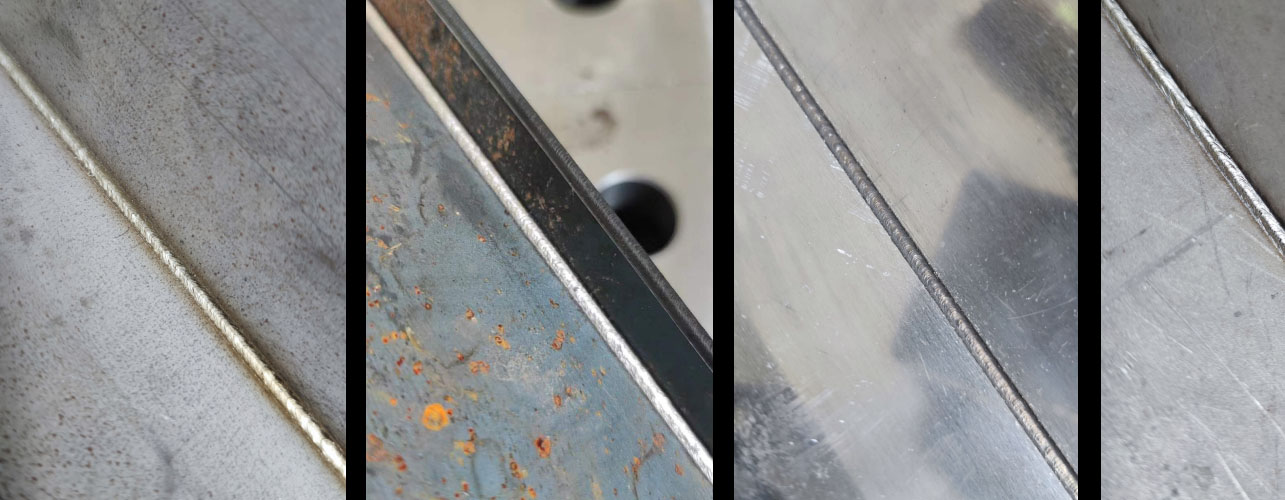
Higher efficiency and process speed
Welding speed can be up to 10 times higher than in the case of TIG or MIG/MAG welding. This difference is particularly noticeable when welding thin materials, where laser allows for smooth and fast weld creation.
This technology also eliminates many time-consuming operations related to material preparation and finishing treatment. The lack of need to clean surfaces from scale, remove spatter or grind significantly shortens project execution time.
High welding speed combined with the limitation of additional operations directly translates to total production time. Projects that would take days using traditional methods can be completed in several hours thanks to laser welding. Additionally, the ability to achieve repeatable welds every time means fewer corrections and reworks, which further increases production process efficiency.
Economic savings
Although the initial investment in a laser welder is higher than for traditional equipment, long-term savings are significant. Laser welding is characterized by lower consumption of operating materials – reduction in shielding gas consumption can be 30-40%, and welding wire 10-15% compared to TIG or MIG/MAG methods.
Elimination of costly finishing operations (grinding, polishing, straightening) significantly affects the total process economics. Savings on an annual scale can reach from tens to hundreds of thousands of zloty and more depending on production scale and type of work performed.
Application versatility
Laser welding stands out for its versatility, allowing the joining of different types of materials, including stainless steels, carbon steel, aluminum alloys, copper and precious metals. It is also possible to weld materials that are difficult to join with traditional methods, such as highly reflective aluminum or copper. Moreover, this technology is also excellent for welding thermoplastics, making it extremely versatile.
This technology works well in various industry sectors – from precision electronics, through automotive and aviation, to manufacturing medical implants. Thanks to the precision of the laser beam, it is also possible to weld elements with complex geometry, including 3D details with hard-to-reach spaces.
Challenges and limitations of laser welding
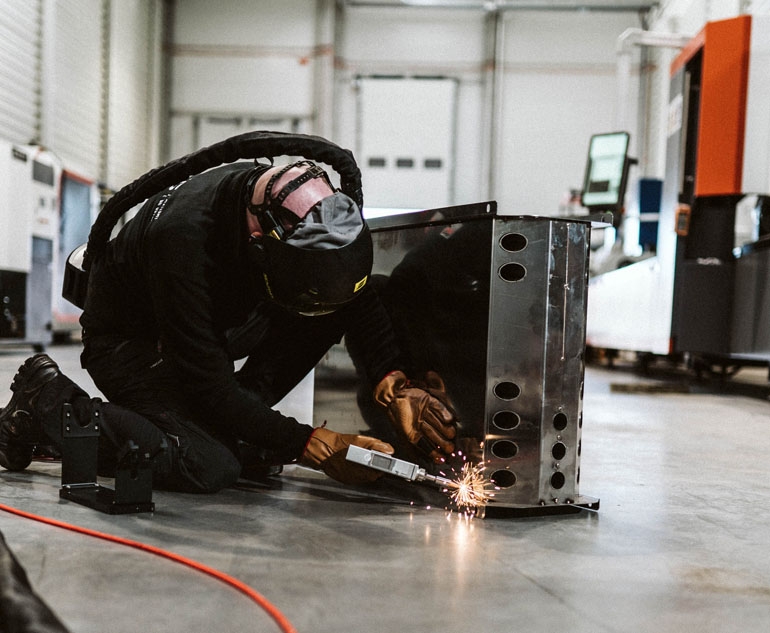
Despite numerous advantages, laser welding involves certain challenges. The most significant is the relatively high initial cost. Professional laser welders are advanced devices whose prices start from tens of thousands of zloty. However, as mentioned earlier, this investment pays back through lower operating costs and increased efficiency.
Laser welding also requires proper element preparation. Precise fitting of joined parts is crucial for achieving perfect welds. This means that the gap between joined elements should not exceed 0.1-0.2 mm. This preparation precision is particularly important when machining thin metals, where even small deviations can affect connection quality.
In terms of material thickness, optimal results are achieved when welding elements with thickness up to 8-9 mm.
Most common applications of handheld laser welding
Locksmithing and metal structure production
In the locksmithing industry, laser welding has revolutionized the production of decorative and structural elements. This particularly applies to railings, handrails, gates and other ornamental steel elements, where weld aesthetics is of key importance.
Precision and minimal thermal deformation make this technology ideal for welding thin-walled profiles and sheets used in "small architecture". The ability to weld without visible heat treatment marks is particularly valued in the production of exposed elements where appearance is a key aspect.
Automotive and aviation industry
In the automotive and aviation industries, where component weight and strength are critical, laser welding finds wide application. It is used to join precision components that must maintain high strength at minimal weight.
This technology also works well in repairs and unit production, where traditional methods could lead to excessive deformation. The ability to weld special alloys, such as titanium or nickel alloys, makes laser welding an ideal solution for advanced aviation applications.
How to choose the right handheld laser welder?
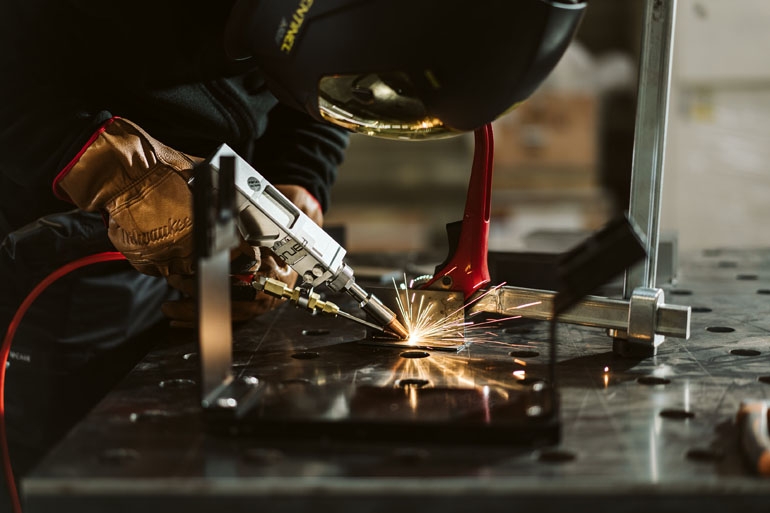
Choosing the right laser welder should consider several key parameters. Laser power determines welding depth and the type of materials that can be joined. For thin sheets and precision jewelry work, devices with power of 1-1.5 kW may be sufficient, while for thicker structural materials, welders with power of 2-3 kW or more will be needed.
Laser operating mode (continuous or pulsed) affects weld character and application possibilities. Pulsed mode provides more precise control over the amount of heat delivered, which is important when welding delicate materials.
An important aspect is also the service and technical support offered by the supplier. Quick access to spare parts, regular inspections and the possibility of technical consultations can significantly affect equipment utilization efficiency. Professional suppliers, often using many years of industry experience, also offer training in laser welder operation, which allows for quick technology implementation in the company.
Real savings and return on investment
Calculation of the payback period for investment in a laser welder depends on the intensity of equipment use. Example savings for typical applications include:
-
reduction of operating material costs by 30-40%,
-
reduction of energy consumption compared to TIG, MIG/MAG methods,
-
elimination of post-processing costs (grinding, polishing),
-
reduction of production time, which translates to higher efficiency.
Long-term economic benefits extend beyond direct savings. Higher weld quality means fewer complaints and warranty repairs. The ability to implement more complex projects allows for gaining new customers and markets.
To better understand the overall economic benefits resulting from the application of modern welding technologies, it is worth familiarizing yourself with our detailed study on welding cost reduction. You will find there detailed analyses and examples of companies that, thanks to implementing laser welding, achieved significant savings and improved their competitive position in the market.
Future of laser welding technology
Laser welding technology is developing dynamically. Current trends include device miniaturization, increasing their mobility and integration with automation systems. Handheld welders with compact dimensions enabling field work are becoming increasingly common.
Predicted innovations concern the development of vision systems supporting the operator, algorithms optimizing welding parameters in real time and new types of lasers with even greater energy efficiency.
Gradual reduction of technology costs is also expected, which will make it accessible to a wider range of recipients. Growing competition in the supplier market and component standardization are factors that will most likely contribute to the democratization of laser welding in the coming years.
Summary and recommendations
Laser welding represents an optimal choice for companies striving to increase precision, quality and production efficiency. It will be particularly beneficial for enterprises specializing in stainless steel processing, production of decorative elements, the medical industry and everywhere where weld aesthetics and precision are of key importance.
When making a decision about implementing this technology, it is worth considering:
-
type and thickness of joined materials,
-
quality requirements regarding welds,
-
production scale and possibility of amortizing purchase costs,
-
availability of technical support and service.
Implementation of laser welding in a company should begin with needs analysis, selection of appropriate equipment and staff training. Many suppliers offer the possibility of testing before purchase, which allows for practical verification of benefits from new technology.
The most important advantages supporting technology change are higher quality and aesthetics of welds, increased efficiency, material savings and the ability to implement projects that would be difficult or impossible to execute using traditional methods. In the long term, laser welding not only increases company competitiveness but also opens new business opportunities.
Are you wondering whether laser welding will work in your company? Take advantage of free consultation with our experts, who will help assess potential benefits for your specific case. During the meeting, we will analyze your production specifics, types of processed materials and current challenges you face. Based on this, we will present a simulation of savings and efficiency increases you can achieve through implementing laser technology. You don't have to make a purchase decision immediately – we also offer the possibility to test our welders on your materials, so you can see with your own eyes the advantages of this technology. Schedule a consultation today and take the first step towards modernizing your workshop.