


Learn about key technical parameters, cost analysis, and implementation aspects that will help you choose the best industrial welders. You'll discover how to match laser power to your production, understand the differences between stationary and portable models, and the real savings from eliminating finishing operations. We'll guide you through production needs analysis, supplier selection criteria, and financing options.
Analysis of your company's production needs
Choosing a laser welder begins with precisely understanding the specifics of your production. A proper needs analysis is the foundation that ensures you invest in a solution that actually accelerates work, rather than generating new problems.
Material identification: steel, aluminum, noble metal alloys, carbon steel, stainless steel
The type of material being processed determines the welder selection. Fiber laser technology handles materials that traditionally cause difficulties very well:
-
Stainless steel - laser welding eliminates the problem of discoloration and deformation, maintaining full anti-corrosive properties.
-
Highly reflective metals (copper, brass, bronze) - thanks to the light wavelength used in fiber technology, these materials can be welded without beam reflection, which is problematic with other types of lasers. Aluminum - while in the TIG method this material requires exceptional precision and experience, FANUCI laser welders allow even novice operators to achieve perfect welds without porosity, which represents a huge breakthrough in aluminum and other non-ferrous metal welding.
-
Titanium and its alloys - particularly valuable in medical and aerospace industries, where weld purity and precision are critical.
To better understand how laser welding technology can optimally utilize the properties of various materials, it's worth deepening your knowledge in this area. Check our Laser Welders Guide, where you'll find detailed information about operating principles, technical parameters, and practical applications of this innovative technology.
Thickness of processed elements and laser power selection
Laser power must be matched to material thickness:
-
Up to 2 mm - a 1000-1500W welder is sufficient
-
2-5 mm - optimal power would be 2000-3000W, ideal for working with thin sheets in workshop applications
-
5-10 mm - for elements of this thickness, a 3000-5000W welder is needed
For material thicker than 10 mm, laser technology mainly makes sense for elements requiring precision and aesthetics, as traditional methods become more economical for standard applications.
Remember: too little power will prevent proper penetration, while too much can cause thermal deformation or burn-through, especially with thin materials.
Work mode: required welding speed and weld precision
When defining requirements, determine your position in the triangle: speed - precision - costs:
-
Priorities in small workshops - usually application flexibility and quality with a limited budget. Consider lower power but with advanced control features.
-
Serial production - speed becomes crucial. Laser welders work 5-10 times faster than TIG or MIG/MAG methods. In producing 100 identical elements daily, a process traditionally taking 8 hours will take only 1-2 hours with laser technology.
-
Precision for decorative/visible elements - choose equipment with advanced pulse control system, enabling regulation of weld width and depth.
Practical example: A company producing stainless steel railings using FANUCI PRO Portable reduced the production time of a single railing from 5 hours to 1.5 hours, completely eliminating the weld grinding stage that took an additional 2 hours.
When analyzing needs, also consider:
-
Current bottlenecks - which stages of the current welding process take the most time or generate the most defects?
-
Development plans - do you plan to expand your offering with new materials or thicknesses in the future?
-
Personnel availability - a laser welder allows an inexperienced worker to achieve results better than those obtained by a multi-year welder using traditional methods, after just one day of training.
The most effective method for verifying needs analysis is practical testing. Reputable suppliers offer demonstrations on your materials, at your facility. This allows for realistic assessment of whether laser welding will actually solve your production challenges.
Technical parameters deciding the welder selection
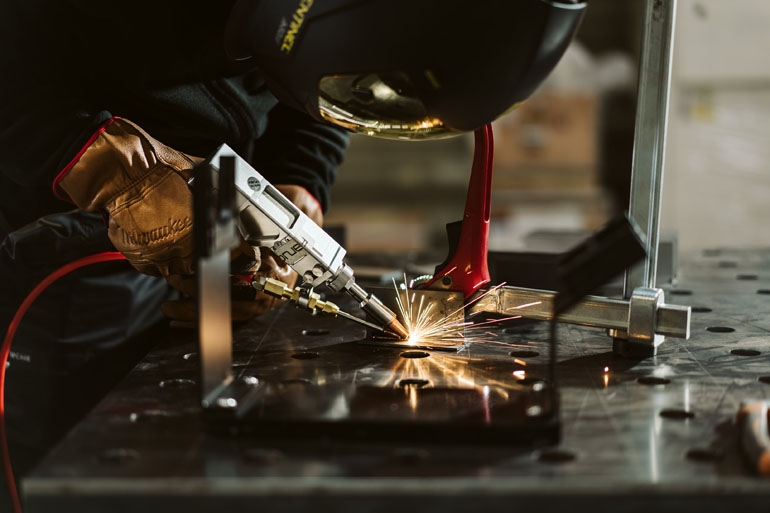
The decision to purchase a laser welder is an investment whose effectiveness depends on matching technical parameters to your production needs. Three key elements worth paying special attention to are output power, control system, and wire feeding mechanism.
Output power and process efficiency
Laser source power is a parameter determining not only the equipment's capabilities but also its price. When selecting power, consider:
-
Actual source efficiency - In FANUCI welders with Fi Power on technology, actual output power reaches 112-120% of the declared value. This translates to arc stability and stable penetration when welding thicker materials.
-
Welding speed - For example, when welding 2mm stainless steel:
-
TIG method: about 10-15 cm/min
-
2000W laser welder: 60-80 cm/min
-
3000W laser welder: 100-120 cm/min
-
The difference becomes even more visible in serial production. When making 50 identical connections daily, a process traditionally taking 6 hours shortens to just 45 minutes with laser technology.
-
Economic effect - Beyond time savings, greater power translates to:
-
deeper penetration in one pass,
-
ability to work with a wider spectrum of materials,
-
fewer passes needed to achieve complete connection.
-
When choosing power, be guided by the maximum thickness of materials you work with:
-
1000W:
- Carbon steel: up to 3 mm
- Stainless steel: up to 3 mm
- Aluminum: 2 mm
- Brass: 0.8 - 1 mm -
1500W - optimal for sheets up to 4 mm:
- Carbon steel: up to 4 mm
- Stainless steel: up to 4 mm
- Aluminum: 3mm
- Brass: 1 mm -
2000W:
- Carbon steel: up to 5 mm
- Stainless steel: up to 5 mm
- Aluminum: 4 mm
- Brass: 2 mm -
3000W:
- Carbon steel: up to 8-9 mm
- Stainless steel: up to 8-9 mm (for both carbon and stainless steel, these values refer to full penetration)
- Aluminum: 6 mm
Remember that fiber laser source lifespan is 50-100 thousand working hours. This means that with single-shift operation, the device will serve you 20+ years without needing to replace the key component.
Control system and remote parameter management
Modern laser welders offer advanced control systems that significantly improve daily work:
-
Wireless controlling tablet - In FANUCI PRO GenX models, the operator can change welding parameters without approaching the device. This seemingly minor function brings surprisingly big benefits:
-
saving 5-10 minutes per hour of work when parameters need to be adjusted for different elements,
-
less operator fatigue when not having to constantly move between workstation and control panel,
-
ability to immediately correct parameters when observing weld imperfections.
-
-
Remote diagnostics - The Fi Power on system enables remote diagnostics and work parameter monitoring, which allows:
-
detecting potential problems before they lead to failure,
-
optimizing work parameters without the need for service visit,
-
shortening downtime in case of malfunction.
-
-
Intelligent presets - Instead of manually selecting parameters for each material, you can use ready settings, which is particularly valuable in industrial plants:
-
select material type (steel, aluminum, etc.),
-
specify element thickness,
-
indicate weld type (fillet, butt, etc.).
-
The system automatically selects optimal parameters for the given application, eliminating the need for time-consuming tests, especially with less experienced operators.
Automatic wire feeder in practice
An element often overlooked when choosing a welder, but having enormous significance for work comfort and quality - unlike traditional solutions like semi-automatic welders or MIG/MAG welders:
-
Automated feeding process - Unlike manual wire introduction in traditional methods, FANUCI laser welders precisely dose the filler material:
-
elimination of weld irregularities resulting from manual feeding,
-
constant wire feeding speed ensuring uniform penetration,
-
ability to work with wires of very small diameters (from 0.2 mm).
-
-
Double feeder system - Models equipped with two independent feeders offer unique capabilities:
-
instant switching between different wire types without downtime,
-
ability to join materials requiring different welding wires,
-
work continuity when one spool is depleted.
-
Thanks to these advanced technical solutions, FANUCI laser welders ensure not only higher weld quality but also significantly increase process efficiency. Proper selection of technical parameters directly translates to faster return on investment and competitive advantage for your company.
Mobility vs stability: choosing between stationary and portable models
The decision between stationary and mobile welders is crucial for production efficiency. Depending on your business nature, the benefits of mobility may outweigh the advantages of a stable workstation, or vice versa.
FANUCI 5.0 PRO GenX – solution for large production halls
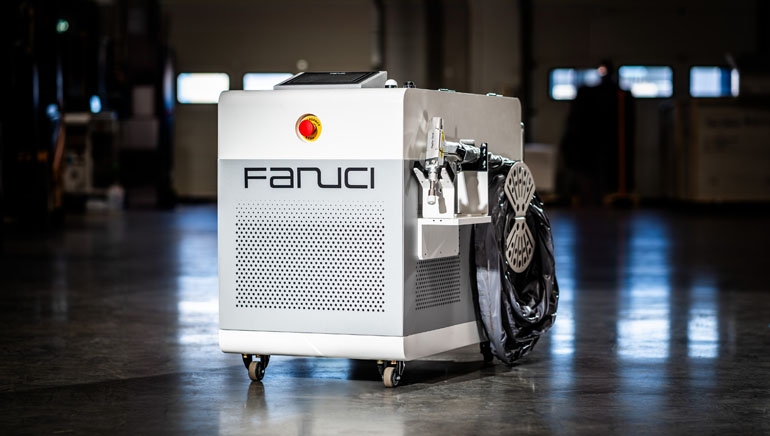
The FANUCI 5.0 PRO GenX model, weighing about 200 kg, offers stability necessary for intensive industrial production:
-
Fixed workstation - designed for hall work. Excellent as a stationary welding station.
-
Work continuity - liquid cooling system enables multi-hour work without technological breaks, which is impossible with lighter models with air cooling.
-
Wider application range - higher power (up to 3400W) enables welding thicker elements and difficult materials like aluminum over 5mm thick, offering a wide range of applications in industrial plants.
In practice, companies producing series of elements with similar parameters achieve the best economic results precisely with stationary solutions. For example, a stainless steel pipe and profile manufacturer can set up FANUCI GenX in the production line where it performs one, repeatable operation, and the greater weight and stability of the device translates to exactly the same weld parameters for each element.
If the operator's work mainly consists of handling materials in one location, and elements can be freely delivered to the welding station, a stationary solution will minimize downtime and increase daily productivity.
FANUCI 5.0 PRO Portable – flexibility in dynamic conditions
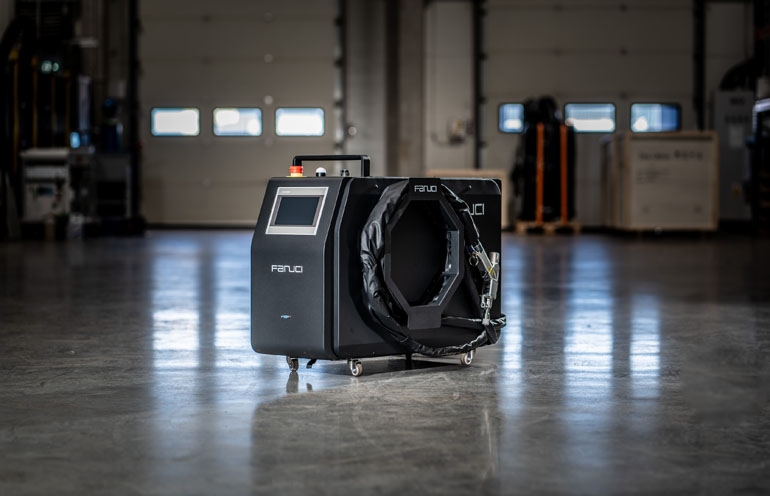
The portable FANUCI 5.0 PRO Portable model weighing about 40 kg was designed for completely different scenarios, similar to compact inverter welders designed for both professional applications and home use:
-
mobility between workstations - ability to move the device within the facility, eliminating the need to transport large elements to the welding station,
-
field work - fulfilling orders directly at the client's site or construction site,
-
limited production space - ideal solution when there's no room for a dedicated, fixed welding station.
Practical example: a company manufacturing stainless steel railings and fencing uses FANUCI Portable during client installation. On-site welding eliminates the need to transport ready, large-scale elements and allows for immediate adjustment in case of unforeseen changes.
Another scenario: a workshop producing decorative elements of varied dimensions and shapes can move the FANUCI Portable between workstations, adapting the process to the size of welded elements without reorganizing the entire production layout.
In case of frequent changes in production profile and work with elements of varied parameters, the portable model offers unmatched operational flexibility.
Safety during intensive operation
Regardless of the chosen model, laser welder safety is crucial both for operators and production process stability:
-
certified components - all FANUCI models are equipped with electrical components with safety certificates that ensure protection against overvoltages and overloads,
-
optical safeguards - multi-level protection against accidental laser beam exposure, with automatic shutdown when potential danger is detected, significantly exceeding the protection provided by standard welding helmets,
-
parameter monitoring - continuous temperature control of key components prevents overheating and potential damage.
Practical advice: when choosing equipment, always verify the completeness of technical documentation and safety certificates. A professional supplier should provide full safety specifications and conduct training on safe operation principles.
When selecting a model for your needs, consider not only the current production profile but also development plans for the next 2-3 years. A laser welder is a long-term investment, so flexibility in adapting to changing requirements may prove as important as current technical parameters.
Investment costs vs long-term profitability
Investment in a laser welder is a decision that must consider not only the purchase price but primarily the total cost of ownership over years. When analyzing profitability, it's worth looking at the welder as a tool for increasing your company's competitiveness, not just as a cost.
Analysis of energy and consumables consumption
Looking only at the initial investment (40,000-140,000 PLN depending on model) doesn't give the full picture. The actual operating costs of laser welders can surprise with their efficiency:
-
Energy consumption in task perspective - Although power consumption per hour is comparable to MIG/MAG and TIG equipment, thanks to faster welding (up to 10x), the actual energy cost per meter of weld is significantly lower, meaning low energy consumption per work performed. Example: Laser welder and TIG with similar 3.5 kW/h consumption, but laser completes 60 meters of weld per hour instead of 6 meters with TIG, giving 0.06 kWh/meter cost instead of 0.58 kWh/meter.
-
Shielding gas consumption optimization - Working at similar working pressure as TIG equipment using welding in inert gas shielding, but with greater welding speed, laser welders consume proportionally less gas per completed task, significantly reducing the need for gas reducers and other gas installation elements.
-
Personnel cost reduction - Eliminating the weld grinding stage is not only savings on abrasive materials but primarily significant work reduction. At larger production scale, this can mean reducing 1-2 positions, which at monthly employee cost of about 7,000-8,000 PLN gives annual savings of 84,000-192,000 PLN.
A comprehensive look at actual savings requires considering all production process components. You can find a more detailed analysis of achievable savings in our article where we present welding costs, where we discuss methods for optimizing expenses at every stage of the welding process in detail.
When analyzing laser welder investment profitability, also consider faster order fulfillment, ability to accept more orders, and offering welding services for difficult materials like aluminum or brass alloys. Each of these factors opens additional revenue streams.
Warranty and service support programs
Production equipment reliability has direct impact on company operation continuity. When choosing a laser welder, pay special attention to warranty and service support issues:
-
Actual warranty scope - FANUCI Pro series welders are covered by a 5-year warranty on the entire device, while the market standard is often shorter periods or warranties limited to selected components. Before purchase, verify exactly:
-
whether warranty covers all components, including the laser source,
-
what are the conditions for claim recognition (e.g., whether regular inspections are mandatory),
-
whether warranty is fulfilled at the customer's site or requires device shipment.
-
-
Service response time - In case of failure, every hour of downtime counts. Effective FANUCI service system works multi-level:
-
First contact with dedicated service coordinator
-
Remote diagnostics solving up to 85% of problems without technician visit
-
In case of more serious failures - service visit within 24 hours
Compare these parameters with other suppliers' offers - difference in downtime can mean thousands of PLN in operational losses.
-
-
Spare parts availability - Key for laser welders is the supplier having a local parts warehouse. Ask the potential supplier:
-
Does it have a physical parts warehouse in Poland?
-
Which elements are available immediately (particularly important are laser sources, heads, electronic components)?
-
How often does it happen that parts need to be imported from abroad and how long does it take?
-
-
Unique solution: replacement source - A unique element of FANUCI support is the possibility of delivering a replacement source during repair time. This practically eliminates the risk of long downtime, even in case of serious failure of the key component. In a real production scenario, this means that instead of several days or weeks waiting for parts, your production can be resumed within 24 hours.
-
Preventive maintenance - Regular inspections significantly reduce the risk of unexpected failures. Check whether the supplier offers:
-
free inspections under warranty,
-
inspection plan adapted to equipment usage intensity,
-
possibility of remote equipment technical condition monitoring.
-
Practical advice: Before finalizing the purchase, ask for references from companies using the given model for at least one year. Real user experiences will give you a realistic picture of equipment reliability and service effectiveness.
When analyzing the total cost of owning a FANUCI laser welder, remember the fiber technology laser source lifespan of 100,000 working hours. In practice, this means that with single-shift work, the device's key component will serve for 20+ years without needing replacement, significantly improving investment economics in the longer term.
Criteria for selecting laser equipment supplier
Purchasing a laser welder is only the beginning of the relationship with the supplier. Years of cooperation with the wrong partner can turn a promising investment into a source of costs and frustration. The following criteria will help you identify a supplier who will provide not only equipment but also support necessary to maximize return on investment.
Verification of safety and quality certificates
Certificates are not just formalities - they guarantee that equipment meets European safety and quality standards, and in case of inspection or audit, you won't expose your company to legal problems.
Before purchase, always verify:
-
CE Declaration of Conformity - this is absolute minimum for any equipment introduced to the EU market. Lack of this document should be an immediate warning signal.
-
Independent testing body certificates - FANUCI welders have TÜV Rheinland and SGS certificates, which testify to passing rigorous safety and quality tests. It's worth asking the supplier to provide copies of these documents and verify their authenticity.
-
Supplementary documents - WPQR certificates confirming quality and durability of welds made with a given welder can prove invaluable when acquiring clients from industries requiring certified processes, like automotive or defense industries.
Practical tip: Ask the supplier to show certificates for individual components, not just the entire device. Companies offering welders assembled from low-quality Asian parts often have general certificates for equipment but not for key components, which can result in safety and reliability problems.
Spare parts warehouse availability and service support
Every day of downtime means real financial losses. When choosing a supplier, pay attention to practical aspects of service support:
-
Local parts warehouse - ask directly whether the supplier has a physical warehouse in Poland with key components such as:
-
laser sources (most frequently damaged element),
-
working heads,
-
optical systems,
-
control systems.
Example: In case of laser source failure, waiting for parts import from Asia can take several months or longer. A supplier with local warehouse, after identifying the fault and including shipping time, can deliver replacement within 48 hours.
-
-
Service response protocol - make sure the supplier has clearly defined failure handling procedure:
-
Immediate contact with dedicated service coordinator
-
Remote diagnostics (solving up to 85% of problems without technician visit)
-
In case of visit necessity - technician arrival time (optimally 24h)
-
Guarantee that technician has appropriate parts during first visit
-
-
Replacement source for repair time - this solution offered by few suppliers constitutes insurance against long downtime. In practice, it means that even with serious failure requiring laser source replacement, your production will be resumed within 24-48 hours.
Possibility of tests in showroom or production conditions
No technical specification or marketing presentation will replace practical equipment testing on your materials and in your conditions.
-
Tests in supplier's showroom - the first step should be a visit to the showroom where:
-
you'll verify actual work parameters (speed, weld quality),
-
test the ease of equipment interface operation,
-
check work comfort with the equipment.
Bring samples of materials you work with most often - especially those that cause problems with traditional welding methods.
-
-
Demo at your facility - a serious supplier should offer the possibility of conducting tests directly at your company along with a complete set of necessary accessories:
-
on actual production elements,
-
in conditions where the equipment will work daily,
-
with participation of personnel who will operate the welder.
This stage allows verification of whether the equipment will actually solve production problems occurring in your company.
-
-
Testing different configurations - during welder demonstration, insist on testing:
-
different welding parameters for the same materials,
-
different weld types (butt, fillet, corner),
-
problematic material welding (if such occur in your production).
-
Practical test scenario: Prepare 3-5 typical production tasks your company faces, including one particularly demanding. Measure the execution time of these tasks with traditional methods, then ask to perform them using laser welder. This direct confrontation will give you concrete data on potential time savings.
Well-conducted tests before purchase is an investment of several hours that can protect you from a misguided investment of hundreds of thousands of PLN. A professional supplier will not only enable such tests but actively help select optimal parameters for your specific needs.
Summary
Choosing the ideal laser welder is a strategic decision that can revolutionize production processes in your company. When selecting equipment, focus on matching technical parameters to the specifics of processed materials and expected productivity. Remember that power of 2000-3000W will work in most industrial applications, and portable models offer flexibility in dynamic production conditions. The initial investment of 50,000-140,000 PLN quickly pays off thanks to 10 times greater welding speed, elimination of finishing operations, and the ability to employ operators without specialized qualifications.
Implementing modern laser welding technology requires careful preparation and choosing the right partner. If you want to see how precise laser welding can transform your production, we invite you to familiarize yourself with our equipment capabilities and practical examples of their application in various industry sectors.