


The proper selection of cutting method should take into account several key factors. First and foremost, the type and thickness of the cut material should be considered — some technologies work excellently with thin sheets, while others are designed for materials of much greater thickness. The complexity of the cut shape and the required precision and edge quality also play an important role. Economic aspects, such as available budget both at the equipment purchase stage and during its operation, remain significant. Let's analyze the available sheet cutting methods, their specificity, and circumstances in which they work best.
Mechanical cutting methods
Shear cutting
Shears represent the most basic method of sheet cutting. They come in various variants: from simple hand tools, through guillotine shears, to advanced hydraulic systems. Their main advantage is simplicity of operation and low cost, especially compared to advanced thermal methods.
Guillotine shears are commonly used for cutting straight elements from sheets up to 10 mm thick, although in small enterprises they are most often used for materials up to 4 mm thick. Modern control systems ensure high cutting precision, minimizing burr formation.
The main limitation of shear technology is the possibility of edge deformation of the cut material and limited precision with more complex shapes. This method works best with straight cuts and elements that do not require high dimensional accuracy.
Saw cutting
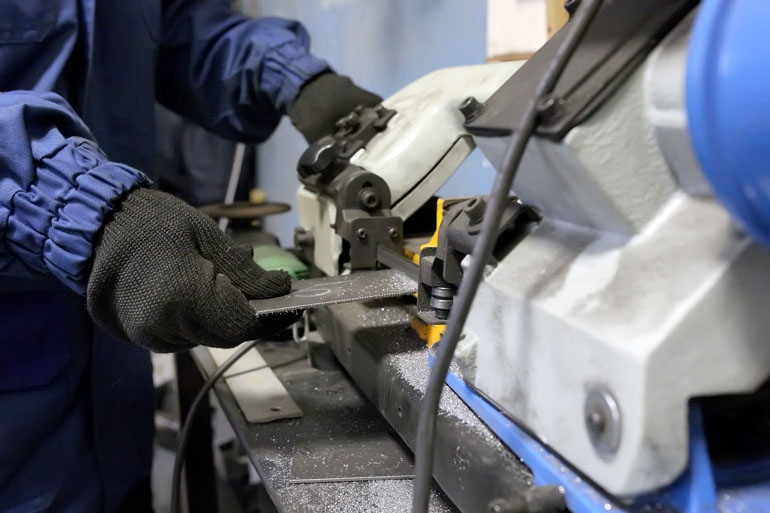
Saws, both band and circular, find application in cutting thicker materials. They enable processing of a wide range of metals, including difficult-to-process ones, such as stainless steel or aluminum.
Depending on the equipment model, material feeding can be manual, semi-automatic, or fully automatic. Available are both simple, portable hand-held cutters and advanced industrial machines with automatic feeding and cooling systems.
The advantages of this method include the ability to achieve relatively high edge quality and versatility in terms of processed materials. However, compared to other technologies, saw cutting is characterized by lower processing speed and often requires additional edge finishing.
CNC punching
Numerically controlled punching machines represent an advanced solution for sheet processing. Contemporary devices are comprehensive machining centers that, beyond basic cutting, offer a range of additional functions such as punching, nibbling, embossing, marking, bending, or threading.
The key advantage of CNC punching machines is high precision and process repeatability, making them an ideal choice for series production. Modern machines have extensive tool magazines, housing dozens of different punches, which enables execution of complicated details in one production cycle.
Although this technology provides excellent results, its significant drawback is high investment costs and the necessity of using specialized tools.
Thermal cutting methods
Oxygen (gas) cutting
Oxygen cutting, also known as gas cutting, is one of the oldest methods of thermal metal cutting. The process involves initial heating of the material to ignition temperature (about 1050°C for pure iron), then using oxygen under high pressure for cutting. Cutting occurs through controlled combustion reaction of the material.
This method is particularly effective in processing non-alloy structural steels. Depending on the type of torch and nozzle, materials from 3 to even 500 mm thick can be cut. Various gases are used for material heating, such as propane, acetylene, propylene, or natural gas.
The main advantages of oxygen cutting are low cost and the ability to process very thick materials. However, this method also has significant limitations: long piercing time, wide heat-affected zone, risk of material deformation, and limited ability to cut alloy steels. Edge quality is also lower than with other thermal methods — the upper edge is usually rounded, and slag may occur on the lower edge.
Plasma cutting
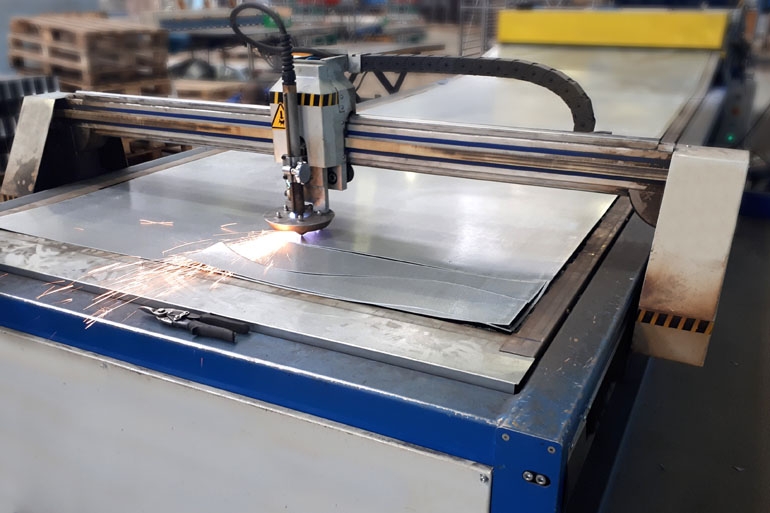
Plasma cutting technology uses highly ionized gas at very high temperature (10000-30000K) to melt material. Plasma is generated by passing compressed gas through an electric arc, creating a concentrated stream at a speed close to the speed of sound.
Plasma cutters can effectively cut electrically conductive materials up to 75 mm thick using conventional systems, and even up to 150 mm using narrow-stream technology. This method provides high cutting speed, especially for medium-thickness materials.
In standard plasma cutting, the edge surface is smooth and even, although slight beveling may occur. The use of advanced plasma sources, technological gases, and liquid-cooled torches allows achieving exceptionally smooth edges with minimal bevel.
The disadvantages of this technology are a larger heat-affected zone than laser cutting and poorer edge quality, especially at high cutting speeds. Additionally, with greater material thicknesses, cutting quality may deteriorate and beveling becomes more visible.
Laser cutting
Laser cutting represents the most technologically advanced method of sheet processing. Using a concentrated beam of light with precisely defined wavelength, the laser heats the material to the melting or vaporization point, enabling extraordinary precision during the cutting process. Laser sheet cutting is widely used in various industrial sectors.
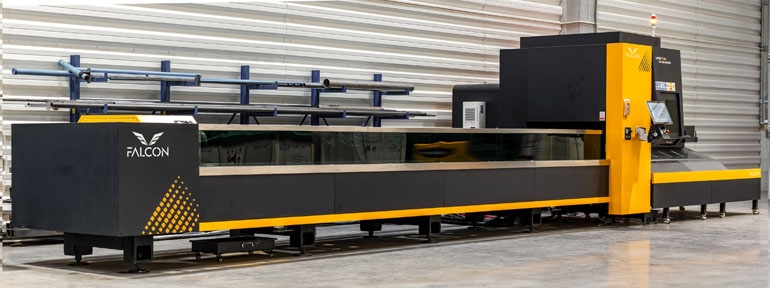
Two main types of laser systems dominate the market:
-
CO₂ lasers - traditional technology, particularly useful for cutting non-metallic materials, requiring an extensive mirror system and characterized by higher operating costs.
-
Fiber lasers - more modern solution, offering higher energy efficiency, precision and speed, with lower maintenance costs.
Modern solutions based on fiber technology have revolutionized the metal processing industry. Fiber laser is gaining increasing popularity due to lower operating costs, greater energy efficiency, and lower maintenance requirements compared to traditional CO₂ systems. Investment in this technology often pays back faster than other solutions available on the market.
The laser cutting mechanism can proceed in three ways:
-
cutting with material combustion — uses exothermic reaction of oxygen with material,
-
fusion cutting — material is melted and blown out of the gap with inert gas,
-
vaporization cutting — material is directly vaporized by intense laser beam.
The main advantages of this technology include unmatched precision (tolerances of 0.1 mm), high edge quality often not requiring additional processing, minimal heat-affected zone, and the ability to cut complex shapes. Disadvantages include high investment costs and limitations in cutting very thick materials (standard systems effectively cut steel up to about 40 mm).
Laser technology works excellently in industries requiring high precision, such as automotive, electronics, or medical industry.
Waterjet cutting
Waterjet cutting is a technology that uses the erosive action of water under extremely high pressure (up to 4000 atmospheres), giving the stream an exit velocity of about 1000 m/s. Depending on the hardness of the cut material, pure water is used (for soft materials like rubber or cardboard) or water with abrasive additives (for harder materials like metals).
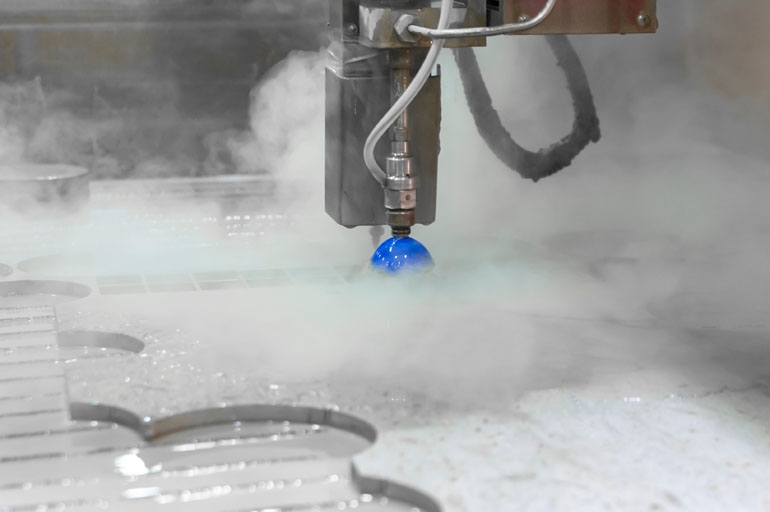
The key advantage of this method is the complete absence of heat-affected zone, which eliminates the risk of thermal deformations and structural changes in the material. Additionally, this technology enables cutting practically all materials, including metals, composites, glass, stone, or plastics, up to 200 mm thick.
Cutting quality can be regulated by adjusting speed and the amount and type of abrasive. With quality cutting, extremely smooth edges can be achieved, at the cost of lower processing speed. Laser cutting, on the other hand, enables obtaining high-quality details in a short time.
The main disadvantages of this technology are relatively low cutting speed and high operating costs related to the consumption of abrasive, nozzles, and high-pressure pumps. An additional challenge is the formation of water mist containing abrasive, which requires appropriate design solutions protecting machine elements.
Selection of appropriate sheet cutting technology
When to choose mechanical cutting?
Mechanical cutting is the optimal choice in the following situations:
-
for simple shapes and small production series,
-
when investment costs must be kept at a low level,
-
when cutting thin sheets, especially when exceptional precision is not required,
-
in small workshops and companies starting their business.
This method is commonly used in small locksmith shops, small production companies, and prototype workshops.
When to choose oxygen cutting?
Oxygen cutting is the best solution:
-
when processing very thick materials (above 50 mm),
-
for non-alloy structural steels,
-
when operating costs must be minimized,
-
in difficult field conditions (possibility of using portable sets).
This technology is most often used by companies in heavy, shipbuilding, railway, and construction industries, where materials of significant thickness are often used.
When to choose plasma cutting?
Plasma technology works best:
-
when cutting medium and thick sheets (up to 150 mm),
-
when good cutting quality is required at moderate costs,
-
when processing various electrically conductive metals (steel, aluminum, copper),
-
when process speed is important, but the highest precision is not required.
This method is particularly popular in heavy industry, steel construction production, machine and vehicle manufacturing, and infrastructure element production.
When to choose laser cutting?
Laser cutting is the best choice:
-
with high requirements for accuracy and edge quality,
-
for complex shapes and precision details,
-
for thin and medium material thicknesses (optimally up to 20 mm),
-
in series production requiring repeatability.
Although the initial laser cutter price may seem high, it should be considered in the context of long-term benefits, such as cutting precision, material savings, and reduction of costs associated with additional processing. Before making a purchase decision, it's worth carefully analyzing your production needs and comparing offers from different manufacturers, taking into account not only the purchase price, but also operating and service costs.
This technology is most often used by companies in the automotive, aerospace, electronics, medical industries, and manufacturers of precision components and decorative metal elements.
When to choose waterjet cutting?
Waterjet technology is the optimal solution:
-
for materials sensitive to high temperature,
-
when cutting without heat-affected zone is required,
-
for various materials, both metallic and non-metallic,
-
for complex shapes requiring high edge quality.
This method finds application in aerospace, space industries, in the production of composite elements, as well as in stonework and glass processing.
Summary
Modern sheet cutting machines offer diverse material processing capabilities, adapted to specific production requirements. The choice between plasma, laser, or oxygen technology should be based on thorough analysis of production type, material type and thickness, and available budget. Comparison of technical parameters and capabilities of individual systems will allow making an optimal investment decision that will translate into production process efficiency.
If you're wondering which technology will best suit your production specifics, we invite you to a free consultation with our experts. During the meeting, we will analyze the types and thicknesses of processed materials, project complexity, and quality requirements to help you select a solution perfectly tailored to your needs and budget. Take advantage of our experience and make an informed decision that will translate into improved efficiency of your production.