


One operator error or lack of proper safety measures is enough for laser cutting to result in downtime, head damage… or something much more serious. Yet most such situations can be predicted – and eliminated – before they even occur. Safety instructions for operating a laser cutter are more than a formality – they are a set of specific practices and decisions that genuinely increase safety. In this article, you'll find guidelines on how to ensure a safe workplace.
Why is safety when operating a laser cutter crucial?
A laser cutter is now a standard tool in facilities dealing with precision metal processing. Laser cutting allows for fast, clean cutting without the need for further grinding or edge processing. But behind this convenience lies real risk – not only for the operator, but also for anyone who gets too close to the workstation.
Hazards you cannot forget about
Laser radiation, especially in high-power devices, is not an abstract theory from a safety manual. It's a concrete threat that can lead to serious eye and skin damage – also through accidental beam reflection from materials such as aluminum or copper. In practice, this means one thing: knowing the machine is not enough. You also need to know how to work with it safely.
Reflected radiation – a hidden danger
A particular risk is accidental contact with a reflected laser beam, especially when working with elements of irregular geometry or shiny surfaces. Not only the working beam itself is a threat – reflections are equally dangerous. This is why optical barriers and machine positioning taking into account the reflection angle are so important.
If someone in your facility approaches too close to the cutter without protection, one beam reflection is enough and... an accident is ready. Therefore, it's crucial not only to equip the operator with appropriate protective equipment, but also to physically separate the workstation so that unauthorized persons don't have access to it.
Mechanical and electrical risks
Besides radiation-related hazards, laser cutters carry additional risks:
-
Contact with moving parts – moving X/Y/Z axes can catch clothing or limbs. The operator should not enter the operational zone of these elements without stopping the device and disconnecting power.
-
Electric shock – especially during device servicing and working with the electrical cabinet. Access to electrical components should be reserved exclusively for trained personnel, and power must be disconnected before any intervention.
The TOP principle – safety hierarchy
In designing safe laser systems, the TOP principle (Technical – Organizational – Personal) applies, which clearly establishes the priority of safety measures:
-
First technical solutions – enclosed machine construction, automatic safeguards, locking systems.
-
Then organizational – training, access control, work procedures.
-
Finally personal measures – protective glasses, clothing, face shields.
This means that the best safety systems don't rely solely on the operator and their personal protection, but primarily on machine construction and engineering systems. The responsibility for safety is clearly divided: the manufacturer is responsible for technical solutions, and the employer – for organizational and selection of personal protective equipment.
Important: Safety regulations related to lasers have a narrower scope than might seem. EU Directive 2006/25/EC specifically concerns optical radiation in the 100 nm – 1 mm wavelength range and protection of skin and eyes. Due to the complexity of laser safety regulations, it's worth consulting with experts before implementing procedures.
Technology that genuinely improves safety
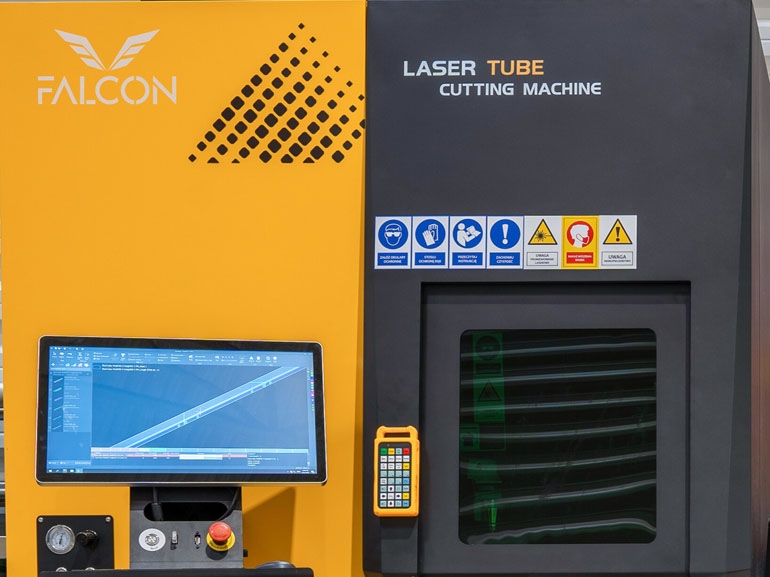
Modern machines, such as Falcon cutters, solve many of these problems at the source. If you have such a machine in your facility or are considering a purchase – it's worth knowing exactly what you're getting.
Instead of manually setting dozens of parameters (where human error is a matter of time), the Tmotion control system automatically analyzes input data and selects appropriate laser power, speed, or head height. You don't have to guess whether gas pressure is correct – the system will do it for you. In practice, this means fewer mistakes, fewer corrections, and – most importantly – lower risk of accidents due to wrong settings.
Falcon machines are also equipped with a range of safeguards that work even when the operator forgets about them:
-
Protection against accidental laser beam exposure – automatic laser shutdown when a threat is detected.
-
Collision sensors – detect obstacles and stop machine operation before collision occurs.
-
Gas pressure regulation – the equipment automatically ensures optimal and stable cutting.
-
Component condition monitoring systems – inform in advance about service needs before something breaks.
-
Temperature control – prevents overheating and failures resulting from overload.
-
Remote control via tablet – the operator doesn't have to approach the machine each time, which reduces time and limits the risk of accidental contact with moving parts.
-
Remote diagnostics – in many cases allows problem resolution without calling service on-site.
What does this mean for you?
If safety matters to you – both for workers and entire production – it's not enough to give the operator protective glasses and sign safety instructions. You need a system that eliminates the possibility of error at the settings stage, that takes care of safety itself, and that simplifies work even for less experienced operators.
The less manual setting – the less risk. And if something goes wrong, modern safeguards will react faster than a human.
Safe work environment – key to risk minimization
In working with a laser cutter, safety doesn't end with the machine itself. What happens around the workstation is equally important. Even the best equipment won't work safely if the operator and environment aren't properly protected.
Limit access – don't risk accidents
In the case of laser cutters, especially with fiber optic technology, a reflected laser beam can cause serious injuries. It's enough for someone unauthorized to enter too close to the work zone at the wrong moment.
Construction requirements for Class 4 devices
Modern Class 4 laser cutters must meet a range of construction requirements that ensure safe use:
-
Light warnings – e.g., above the entrance to the laser zone, signaling active device operation.
-
Door safeguards (interlocks) – automatically interrupt laser emission when access to the danger zone is opened.
-
Service locks – openable only with tools, limiting access to the machine interior.
-
Optical filters – that don't increase the laser class even during scanning system failure.
-
Key switches – only authorized operators can start the machine.
Technical access limitation to laser zone
The workstation should be equipped with systems that actively control access:
-
Contact mats – door sensors connected to the laser safety circuit.
-
Protective curtains – mobile partitions and shields (e.g., made of Makrolon).
-
Clear markings – which must be understandable to workers in the local language.
-
Physical barriers – not tapes or signs, but structures that actually prevent unauthorized persons from approaching.
Remember: Simply owning a certified machine doesn't absolve you of responsibility for how it's used. Even if the cutter has safety certificates – the user is responsible for how and where it's used. This requires knowledge of usage standards such as TROS or IEC 60825-14. Before purchase, it's worth checking whether the manufacturer provides detailed information about proper device use and offers operator training.
Parameter control
The second key element of a safe work environment is continuous supervision of machine condition. Because often an accident doesn't start suddenly – it "builds up" due to minor negligence that could have been caught earlier.
What can be done?
-
Monitor temperature of key components – overheating is one of the main causes of failures and fires.
-
Track optical system condition – dirty or worn elements can lead to incorrect beam emission.
-
Receive notifications about approaching service – before something breaks, not after the fact.
In practice, if you use a device that automatically informs you about optical system contamination or temperature exceedance, you have a chance to react in advance – without downtime, without risk.
Modern laser sources, like Fi Power on, also provide remote diagnostics and work parameter monitoring, which means up to 85% of problems can be solved without waiting for a service technician.
Intelligent safeguards and laser machine functions
In daily work with a laser cutter, what matters is not only how accurately it cuts, but also whether it does so safely – every time and regardless of the situation. That's why more and more companies choose devices that automatically respond to potential threats before the operator manages to notice them.
Automatic shutdown and blocking systems – they react faster than humans
In modern cutters, safety isn't an add-on. It's built into the device logic. For example:
-
If the machine detects incorrect movement, open chamber doors, or laser beam threat – it stops work immediately.
-
When an unauthorized person approaches the cutting zone – the system blocks laser emission, without need for operator intervention.
Importantly – all electrical components are protected against surges and overloads. So if something goes wrong with the installation – you don't risk equipment damage or worker endangerment.
Collision sensors – because not every sheet is perfect
In production conditions, it's difficult to have perfectly flat material. Sometimes the sheet is slightly bent, has an edge fold, or point deformation.
In older devices, this often meant head collision with material, and then costly downtime and repair.
Modern cutters, such as Falcon, solve this differently:
-
Sensors analyze material surface before and during cutting.
-
If they detect unevenness, the system automatically changes the cutting path or stops the process before damage occurs.
Result? The head remains undamaged, and the operator doesn't have to manually check sheet condition each time.
How does machine choice affect work safety?
In many facilities, it's precisely the choice of a specific laser cutter that determines whether operator safety will be genuinely protected or only exist on paper in safety instructions. While equipment price can be a key criterion when purchasing, it's worth knowing what you're actually buying with the machine – or what you might not get. Investment in modern laser technologies is not only about production efficiency, but primarily about team safety.
A machine that stops itself before something goes wrong
Modern cutters – like those from the Falcon series – have built-in systems that detect threats and stop the machine automatically, without operator involvement. If the laser beam could pose a threat, the device interrupts work. If an error sensor detects an abnormality – a block appears and information about the problem.
You don't have to guess whether everything works correctly – the machine informs you. Unlike simpler solutions that rely solely on face shield and operator experience, here the reaction is immediate and precise.
Additionally, Falcon series devices are built from certified components (e.g., compliant with TÜV Rheinland and SGS standards), which ensures their electrical systems are protected against overload. This is particularly important in industrial conditions where voltage spikes are not uncommon.
Systematic approach to safety
Professional laser machines are designed according to PN-EN ISO 12100 and PN-EN ISO 11553-1 standards, which means a systematic approach to hazard identification and elimination. These aren't random solutions, but the result of rigorous risk analysis compliant with international machine safety standards.
The manufacturer's risk assessment documentation confirms that all implemented hazard-minimizing measures have been evaluated as effective in industrial practice. This means safety isn't just a marketing declaration, but translates into controlled, verified practice.
Remote control and diagnostics – real time savings and lower error risk
In daily machine work, it matters enormously whether the operator has to constantly approach the control panel or can control the device from a tablet level. This small difference translates to:
-
less unnecessary movement,
-
less operator fatigue,
-
faster response to cutting parameter changes.
Additionally, if the machine offers remote diagnostics – e.g., through systems like Fi Power on – you can detect and solve most problems remotely, without waiting for service. In many cases, quick error analysis is enough to reset settings or restore operation.
This isn't just convenience – it's also fewer downtimes and lower risk of accidents resulting from improper response to malfunction.
What to pay attention to when purchasing?
Before deciding on a specific model, check:
-
Does the device have automatic safeguards and error sensors that stop work in case of threat?
-
Do collision sensors modify the cutting path in real-time, or only stop the machine after the fact?
-
Does the supplier provide remote support and diagnostics that shorten failure response time?
-
Does the device have current safety certificates, or only catalog assurances?
-
Is the system completely closed, or does it require interior access during service? This affects the need to appoint a laser safety officer.
-
Are complementary products such as protection systems or safety accessories included in the offer?
It's also worth checking other users' opinions about the specific model and learning about shipping and service conditions offered by the supplier.
Because ultimately it's not just about the machine cutting well. It's about doing it safely – today, in a week, and in a year.
Who is an LSO and when must you have one?
Safety in working with laser cutters isn't just about good machines and protective equipment. For higher class devices, regulations require appointing a specially trained laser safety officer.
When is an LSO mandatory?
According to regulations (OStrV / TROS), every employer operating Class 3R, 3B, or 4 laser devices must designate at least one Laser Safety Officer (LSO). For Class 3R and higher laser devices, regulations require appointing a specially trained laser safety inspector who supports the employer in risk assessment, implementing safeguards, and personnel training.
Important exception: If the device is completely enclosed and all repairs are performed exclusively by the manufacturer – an LSO may not be required. However, this must be documented in the operating manual. But if the company independently performs service work or has access to the system interior where higher class radiation occurs – an LSO is mandatory.
What requirements must an LSO meet?
This isn't a role that can be entrusted to just anyone. An LSO must:
-
have technical, scientific, or medical (or cosmetic) education,
-
have at least 2 years of laser work experience,
-
complete specialized training ending with an exam,
-
regularly renew qualifications – every 5 years.
An LSO must have confirmed technical qualifications and be regularly trained – one initial training isn't enough. This is a real, specialized role in the safety structure.
What does an LSO do daily?
In companies using Class 3B and 4 laser cutters, the LSO is responsible for practical safety aspects:
-
conducts initial and periodic laser safety training,
-
designates and marks controlled zones,
-
selects and supervises use of personal protective equipment,
-
reports irregularities and cooperates with safety and occupational health departments and company physician,
-
conducts risk analysis and proposes protective measures.
This is a position that combines technical knowledge with operational practice – marking hazard zones, supervising protective equipment, and conducting refresher training for workers.
Safety training – not just at the beginning
One of the LSO's key tasks is ensuring all workers with access to the controlled zone are properly trained. Training must be regularly repeated – at least once a year. Only trained persons can stay in the controlled zone.
The laser cutter safety instructions developed by the LSO must include:
-
MPE (maximum permissible exposures) for the given laser type,
-
direct and indirect radiation-related risks,
-
emergency procedures and accident response actions,
-
principles of selecting and using personal protective equipment.
Workers should be able to ask questions about safety procedures, and the LSO must be prepared to provide comprehensive answers.
Selection of personal protective equipment – details matter

The LSO is also responsible for proper selection of personal protective equipment, which must be matched to the specific laser type:
-
Protective glasses must have appropriate OD attenuation level and meet EN 207/208 standards, depending on laser type and wavelength. These aren't universal glasses – each wavelength requires different protective parameters.
-
Protective clothing must be not only work clothing, but flame-resistant and non-reflective. The operator cannot wear light-reflecting elements (watches, metal decorations) that could cause unpredictable laser beam reflections.
-
Alignment goggles for visible beam work – specialized equipment for precise adjustments.
Example: glasses protecting against fiber laser (1070 nm) will be completely different from those for CO2 laser work (10600 nm). Using wrong glasses can prove ineffective. Similarly, operator clothing isn't just a face shield and glasses – but also appropriate work clothing that protects against reflected and thermal radiation burns.
What authority does an LSO have?
An LSO doesn't need authority to issue service orders if not serving as a supervisor. In such cases, their role is advisory and supervisory. However, the employer can formally assign these authorities – then the LSO can actually make decisions and issue orders regarding laser safety.
This is an important distinction, especially if you're a company owner or production manager wondering how to formally organize safety responsibility.
Regular maintenance and service – foundation of safe operation
Choosing a good machine is one thing. But even the best equipment, if not properly serviced, eventually stops being safe. Instead of a reliable work tool, it can become a source of risk. That's why one of the most underestimated safety elements in laser cutter work is regular maintenance – planned, professional, and implemented according to schedule.
Inspections
A cutter works daily, often in multi-shift mode. Even if everything works correctly, it's worth adopting the principle: better to check in advance than react after failure.
Standard service inspection performed every six months includes:
-
complete gas and water installation control,
-
electrical cabinet inspection,
-
replacement of consumable materials,
-
cleaning, tests, and dozens of points checking key component operation.
Safety system testing – key inspection element
Special attention should be paid to cyclical testing and documenting emergency system operation:
-
Emergency stop button (E-Stop) – even the best system is useless if it doesn't work when threatened
-
Door locks and interlocks – must immediately interrupt laser emission
-
Safety sensors – responsible for detecting presence of people in the danger zone
Testing these functions should be part of the safety schedule, and their execution must be registered and documented. This isn't just a formal requirement – it's real control over whether protective systems will work when needed.
Such an inspection takes a whole day – and that's not by accident. Its purpose isn't just to "check off points from a list," but real prevention of failures that could appear in weeks or months. Especially with intensive operation, postponing inspections "for later" can mean a costly mistake.
Spare parts available on hand – a difference seen in days (not weeks)
In failure situations, service response time is counted in hours, not days. But even the best service technician can't help if you have to wait for parts delivery from the other end of the world.
That's why it's worth checking whether the equipment supplier has a local spare parts warehouse.
What this means in practice:
-
a source replacement can reach the facility within 48 hours,
-
most failures can be repaired without sending the machine away,
-
there's no risk of downtime due to lack of a small but crucial element.
This is particularly important compared to equipment imported from outside the EU – where waiting time for parts can take weeks, and downtime costs quickly exceed purchase savings. It's also worth checking whether spare part prices are given net or gross, which affects maintenance budget planning. Before adding a machine to cart, it's worth ensuring the supplier offers comprehensive service support in the local market.
Remote diagnostics and replacement sources – concrete advantage in crisis
In case of failure, what matters isn't just that service will come. What matters is what they can do before they even arrive on site.
Modern diagnostic systems allow:
-
online machine connection,
-
reading error codes and operating parameters,
-
remote reset or device operation restoration.
Thanks to this, up to 85% of problems can be solved without technician visit. And if repair requires physical intervention – in most cases it happens within 24 hours. Importantly, the technician arrives with a complete set of parts – so repair happens on the first visit.
And in the worst-case scenario – e.g., laser source failure? Professional service can deliver a replacement source that enables production resumption even before repair completion. As a result, production returns to normal in 24-48 hours, even with serious failure.
A machine can be excellent, but it's service – fast, available, and effective – that determines whether your production will be continuous and safe. If you want to avoid stress and costly surprises, maintenance shouldn't be an "option" – but part of safety strategy.
Where to look for official guidelines?
If you're creating your own safety instructions or want to ensure you comply with all requirements, it's worth knowing key reference documents:
Basic safety standards for laser products:
-
IEC 60825-1 – general safety standard for laser products, defining device classes and basic protective requirements.
-
IEC/EN TR 60825-14 – user guide containing practical guidelines for safe use of laser devices in industry.
Additional protection-related standards:
-
ISO 11553 – safety of laser machines for material processing,
-
PN-EN ISO 12100 – general principles of design, risk assessment and risk reduction,
-
ISO 14123 – machine safety - fixed and movable guards,
-
EN 207/208 – eye protection equipment against laser radiation.
Legal regulations:
-
EU Directive 2006/25/EC – minimum safety and health requirements related to worker exposure to artificial optical radiation,
-
OStrV – German implementation of EU directive,
-
TROS – technical rules implementing OStrV, containing threat assessment methods and protective measures.
Remember: If you're creating your own safety instructions, make sure they comply with Directive 2006/25/EC and TROS guidelines – these regulate safe laser use in work environments. Knowledge of these documents shows professional approach to safety and can be crucial during inspections or audits.
Summary
Safety when operating a laser cutter isn't a matter of chance or luck. It's the result of decisions made every day – from machine choice, through workstation organization, to service approach. Where routine begins to replace vigilance, mistakes are easiest to make. And where everything works "as always," it's easiest to overlook something.
It's crucial to understand that safety standards are divided into two categories: those concerning equipment construction (manufacturer responsibility) and those concerning usage methods (user responsibility). Even the best-protected machine requires a conscious and responsible operator and proper workstation organization.
Equally important is understanding that safety isn't just technology, but also people and procedures. For higher class laser devices, it's mandatory to appoint a qualified laser safety officer (LSO) who will supervise all aspects of safe operation – from worker training to risk analysis and hazard zone marking.
Therefore, it's worth looking at safety instructions not as an obligation, but as a tool for real control over what happens in the facility. From this begins continuity, efficiency – and safety.