


In metal cutting, precision is not a luxury – it's a necessity. And precision in laser cutting machines depends on one thing: the head. In the fiber technology era, it's precisely this element that transforms raw laser power into a perfectly cut part. In this article, we'll examine how laser heads work and what makes Falcon cutting machines a class of their own.
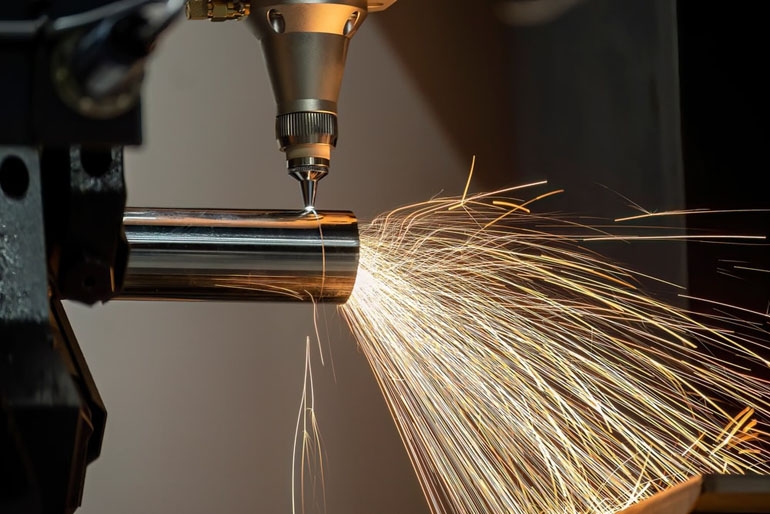
How does a laser cutting head for metal cutting work and why does fiber technology give an advantage?
The laser cutting head is the most important component of the cutting machine – it's responsible for focusing the laser beam at one point, where material cutting occurs. In fiber technology, all laser power is transmitted through an optical fiber, then shaped by lenses and collimators in the head. Precise control of focal length and head distance from the material directly affects cutting quality. The cutting head moves along a previously established path, guided by software, in other words, the CNC control system is responsible for head movement, which controls its position on the X, Y, and Z axes, and also regulates laser output power depending on material, thickness, and selected operating mode. Thanks to this, the cutting machine automatically recognizes variable sheet thickness or profile and optimizes settings without operator intervention. In the case of Falcon laser cutting machines, this system enables both flat cutting and cutting at 45-degree angles. When equipped with an additional arm, advanced 3D cutting can be performed. Additionally, the use of cutting with technological gases under high pressure, such as nitrogen, allows for obtaining clean edges without oxidation – which is particularly important when working with stainless steel.
Falcon cutting machines are fully compatible with automation systems, which allows for even better integration with production lines.
Read: Why is a fiber laser a good investment?
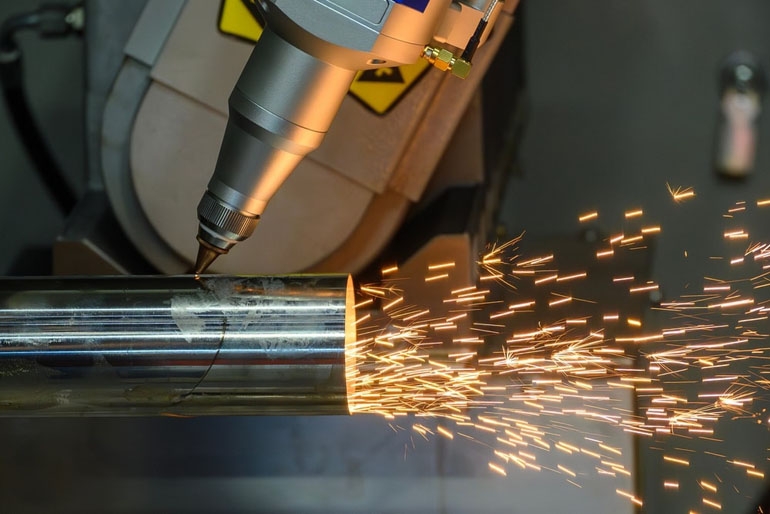
Laser cutting parameters that matter
In practice, a shorter lens focal length (e.g., 125 mm) enables more precise cutting of thin materials, providing a narrow and intense focus point. However, this requires very precise adjustment of head height relative to the workpiece to avoid cutting errors. A longer focal length increases tolerance for material irregularities but slightly reduces precision – therefore, proper selection of parameters for the specific task is crucial.
Check: What is CNC laser?
Similarly, collimator length (e.g., 100 mm) affects beam shape: a shorter collimator gives a shorter section of ideal focus, which is an advantage when cutting thin sheets, while a longer collimator works better with thicker ones.
In the case of laser cutting, a key factor to consider is the thickness of the processed material. Fiber technology handles thin sheets excellently, offering very high quality and cutting speed. However, for thicknesses exceeding 25 mm, alternative methods must be considered or investment in higher power equipment – preferably above 6 kW. This is well illustrated by the table below:
|
Laser Power |
Mild Steel |
Stainless Steel |
Aluminum |
|
1 kW |
up to 8 mm |
up to 4 mm |
up to 4 mm |
|
2 kW |
up to 12 mm |
up to 6 mm |
up to 6 mm |
|
3 kW |
up to 16 mm |
up to 8 mm |
up to 8 mm |
|
4 kW |
up to 20 mm |
up to 10 mm |
up to 12 mm |
|
6 kW |
up to 25 mm |
up to 12 mm |
up to 15 mm |
From the above comparison, it follows that the higher the laser power, the wider the spectrum of materials and thicknesses possible for effective cutting – without compromising quality. In practice, this means that for cutting stainless steel or aluminum of greater thickness, it's worth choosing equipment with at least 3-4 kW power, and for more demanding applications – even 6 kW and more.
Learn more: How and with what to cut sheet metal?
Cutting head in Falcon cutting machines – what distinguishes them in practice?
One of the most important elements of Falcon cutting machines is obviously the modern laser head from renowned manufacturer Precitec, designed with maximum stability, speed, and flexibility of the cutting process in mind. It's precisely this that determines what the final part looks like, how many operations need to be performed, how long the machine works without downtime – and how much each cut meter actually costs. Falcon cutting machines use a head optimized for industrial cycle work, also at high laser power. Thanks to extended cooling paths and intelligent airflow management, the cutting head maintains constant temperature and cutting parameters even under full load conditions. This means not only higher edge quality but also less wear of consumables and longer component life.
Head flexibility allows optical configuration to be adapted to specific tasks
The cutting heads with which our cutting machines are equipped optimize the cutting process thanks to the Auto-Focus system, which automatically adjusts lens position to changing material thickness.
Automatic material piercing system significantly shortens the production cycle
Regardless of material thickness, the head itself selects optimal "piercing" parameters, which ensures uniform hole quality and allows for limiting the need for corrections. This solution is particularly appreciated in serial production, where every second matters.
Integrated sensors continuously monitor the condition of key components
Cutting efficiency is additionally influenced by: integrated cooling, collision sensors, and process monitoring systems, ensuring the highest level of safety and reliability. The user receives information about possible wear or optics contamination, planning service in advance and avoiding downtime. Importantly, head condition can also be monitored from mobile devices – in practice, this means greater safety and lower operating costs.
The head in Falcon cutting machines is not only precision but also speed. Thanks to optimized construction, it's possible to increase cutting speed by up to 75%, which translates to better machine utilization, higher productivity, and shorter investment return time.
Main benefits of choosing Falcon or Tekio cutting machines
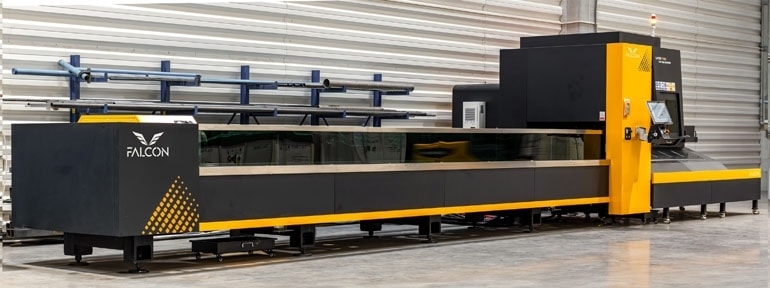
Falcon is a solution for companies that need equipment ready for continuous operation – reliable, fast, and configurable. Systems for cutting sheets, tubes, and profiles are available in various power variants and can be equipped with a range of automation features. This is an ideal solution for the automotive and steel industries, but also for precision component manufacturers, where every millisecond and micron matter.
On the other hand, Tekio laser cutting equipment consists of devices created with users in mind who focus on proven technologies and reasonable budget. This is a choice for companies that need good cutting quality but not necessarily the full package of premium-class solutions. Tekio works excellently for simple production tasks and everyday processing of standard parts – where ease of operation, service availability, and quick implementation matter.
See how Falcon and Tekio capabilities look in practice on our YouTube channel:
Sheet metal laser cutting machine in practice
Most frequently asked questions when purchasing a laser cutting machine
What to pay attention to when choosing a cutting head in laser cutting machines?
For many investors, choosing a laser head is a detail – for professionals, it's the starting point for the entire cost-effectiveness calculation of purchasing a cutting machine. In Falcon models, this element is not just an optical component but the central point on which cutting quality, work pace, and actual operating costs depend. What should you pay attention to when planning an investment in industrial-class equipment? First of all – laser source power. If you plan to work with thicker steel sheets, profiles, or tubes, power reserve will be necessary. Falcon cutting machines are available in two main variants:
-
Falcon T Masterline tube and profile cutting machine – optimized and designed for precise cutting of tubes and profiles up to 12 meters long (6 m on the feeder and 2 m on finished element discharge); depending on configuration, it can be additionally equipped with weld seam reading, manual and automatic loading, or waste-free cutting mode or open tube cutting mode with square cross-section;
-
Falcon S Masterline sheet cutting machine – dedicated to cutting sheet metal, additionally equipped with automatic nozzle exchange and cleaning and e.g., tower system for sheet storage or hydraulic table exchange, cutting versatility: sheets, steel, including carbon steel, aluminum, copper, and even brass.
Both models offer impressive maximum fiber laser power – up to 24 kW – which ensures flexibility in processing both thin parts and demanding elements of greater thickness.
Optical configuration is also important: collimator length and lens focal length directly affect how precise the beam focus point will be. Shorter focal length allows cutting thin materials with high precision but requires very precise working distance adjustment. Longer – though slightly less precise – guarantees greater tolerance and safety with thicker sheets. Falcon models offer a full range of focal lengths – from 150 to 350 mm – and a 100 mm collimator, so the machine can be perfectly adapted to a specific work profile.
No less important are process automation functions – installed laser heads in Falcon cutting machines offer, among others, an automatic material piercing system that shortens production cycle time and ensures repeatable hole quality. Integrated sensors continuously monitor lens condition and cutting process parameters, and the user can check their condition in real-time through a mobile application. This approach allows for advance service planning and avoiding unplanned downtime.
If you're interested in three-dimensional cutting – e.g., in the automotive industry – it's worth knowing that 3D systems require the use of an additional arm or integrated 5-axis machine. This solution is particularly useful for cutting spatial profiles or stamped parts. In this area, Falcon T Masterline offers full compatibility with 3D cutting systems and supports cutting at angles up to 45 degrees. Additionally, built-in intelligent sensors maintain parameter stability even with variable part geometry, which contributes to reduced rejects and ensures production repeatability.
In short – the cutting head is not a detail but a foundation. The better you match it to your processes, the more you'll gain from the entire laser cutting machine investment. Need support? Write or call us!!
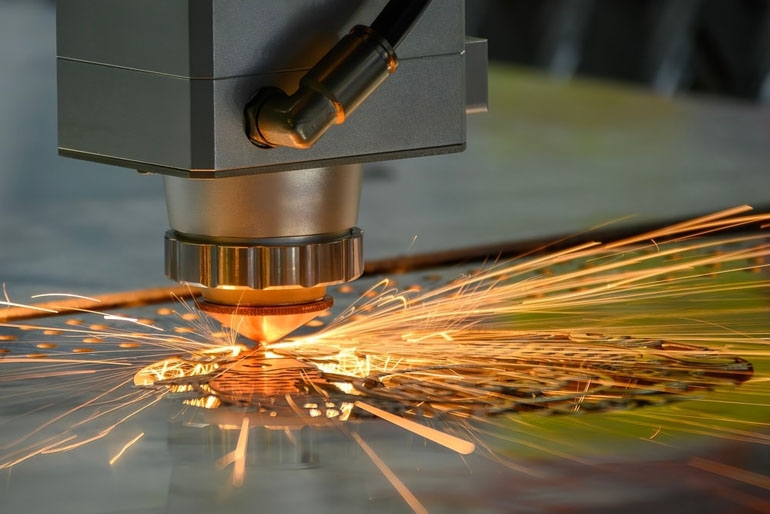
Why is it worth choosing Falcon cutting machines?
Investment in Falcon cutting machines is not just purchasing a machine – it's a decision to increase production efficiency and move to a higher technological level. We integrate the most advanced laser heads with advanced CNC control, process automation, and premium-class components. Thanks to this, Falcon fiber technology laser cutting machines are ready for Industry 4.0 challenges – they support full automation, digital parameter monitoring, and thanks to flexible configuration, they can be easily adapted to changing production needs. Compared to competitive solutions – they constitute a significant advantage in terms of reliability, compatibility with production management systems, and expansion possibilities. It's a choice that pays off not only today but also in a few years.
Do you have questions about laser power selection, head configuration, gas selection, or pieces per hour? Contact a CNC Machine Center advisor. Check which set will be optimal for your production – because every decision matters!