


In this article, we present you with the essence of knowledge that will allow you to take care of laser work safety, master this technology, and sleep peacefully knowing that your operators are safe.
Protective measures in laser work
Hazards, or invisible laser radiation
The most dangerous aspect of working with lasers is the very nature of the fiber laser beam. It operates in the near-infrared range (around 1060 nm), beyond the range of visible light, which means it is invisible to the human eye. Unlike low-power devices, such as lasers emitting visible radiation (e.g., pointers), where direct looking into the beam causes instinctive defensive reactions (blinking, turning the head away), this mechanism is absent here.
It should be remembered that not only the direct beam is dangerous. In the case of Class 4 lasers, both radiation reflected from shiny elements and that which creates dangerous diffuse reflections from matte surfaces is potentially hazardous. Similar risk applies to eyes and skin. Direct contact with the beam can cause skin damage in the form of deep thermal burns.
In the professional approach to safety, the TOP principle applies (Technical – Organizational – Personal). This is a hierarchy that clearly states: first technical safeguards built into the machine, then organizational procedures in the company, and only at the very end personal protective equipment.
Individual protection - how to select eye and skin protection against laser radiation
-
Protective glasses: In this case, proper eye protection is crucial. Certified protective glasses (compliant with PN-EN 207) must be precisely selected for the power and specificity of the laser radiation you work with, that is, for the specific wavelength range. The LB marking on the frame indicates the protection level. The higher the number, the better. Regular sunglasses or welding glasses do not provide protection against fiber laser radiation.
-
Protective clothing: Clothing made of flame-resistant materials, preferably in matte colors, covering the entire body. Add leather gloves and an apron for manual welding. Watches, jewelry, and other reflective objects must disappear from the work zone.
This is particularly important when precision laser welding comes into play, where the operator works in close proximity to the radiation source.
Collective protection
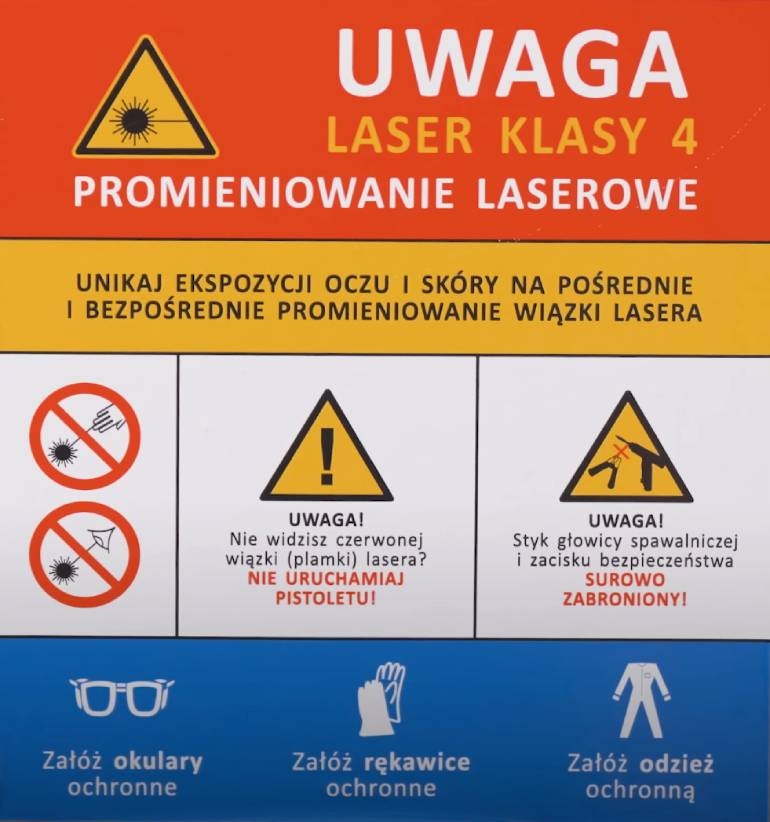
The best protection is one that works independently of humans. This is the "T" in the TOP principle.
-
Enclosures and curtains: The safest laser is a closed laser. Complete enclosure with filtering windows (compliant with PN-EN 12254) changes a Class 4 machine into a safe Class 1 device. If working in an enclosure is impossible, the zone must be separated with special laser curtains or screens that will absorb accidental laser beams.
-
Machine safety systems: Every professional Class 4 laser must have a series of technical safeguards: key switch, door interlocks (so-called interlocks that immediately shut down the laser when the cover is opened), and light and sound signaling. These systems must be reliable, designed according to ISO 13849-1 standard, often at safety level PL=d or PL=e.
-
Intelligent safeguards: Modern machines have active systems that react faster than humans. Collision sensors stop the machine before the head hits the material. Systems monitor temperature and optics condition, informing about wear in advance. Some controllers can even automatically select cutting parameters, minimizing the risk of operator error.
-
Ventilation and dust removal: An effective extraction and filtering system is mandatory. Extraction should remove fumes directly from the working chamber. Modern machines have integrated cartridge filters that must be regularly serviced.
Procedures and work organization
This is the "O" in the TOP principle – your contribution to safety.
Occupational risk assessment
Before the first employee touches the laser, you must have a complete occupational risk assessment on paper. You must analyze all possible scenarios – from the risk of direct radiation exposure to fire and compare potential exposure with threshold values, which is the maximum permissible exposure (MPE).
Training and supervision
In Poland, there are no formal, state qualifications for operating laser welders or cutters. Operator training often lasts one day, and welding basics can be grasped in 15 minutes. That's exactly why the quality of training provided by the machine supplier and internal supervision is so enormously important.
Although operating modern equipment is intuitive, it's worth delving into the subject to fully utilize their potential.
>> Read: Complete guide to laser welding – everything you need to know
The company should designate a Laser Safety Officer (LSO). This cannot be a random person. Requirements typically include technical education, minimum 2 years of experience with lasers, and completed specialized training with an exam, renewed every 5 years. Their tasks include conducting training (minimum once a year), during which employees are informed about potential hazards and safe work principles, selecting protective equipment, and auditing safety.
Workstation organization
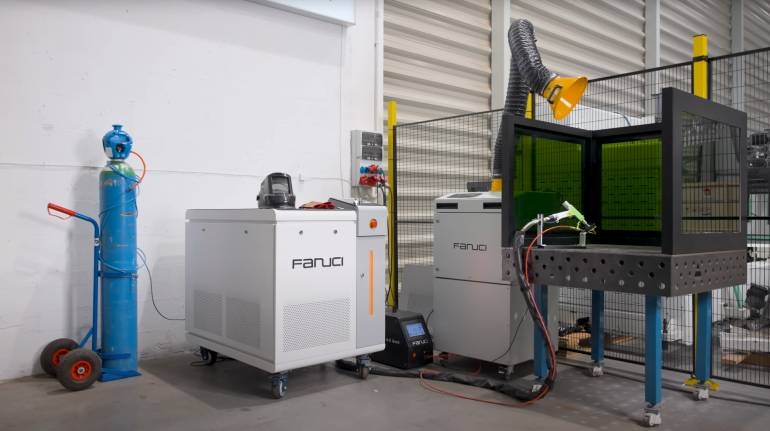
A laser workstation must be a clearly designated and marked hazardous zone. Only authorized and trained persons equipped with appropriate protective equipment may have access to it. The rule is simple – no authorization and glasses, no entry. All reflective surfaces and unnecessary objects must be removed from the vicinity, and observation of the workplace through optical instruments without appropriate filters is absolutely forbidden.
Maintenance and inspections
Regular technical inspections are mandatory. Professional suppliers require warranty inspections every few months. This involves parts replacement and safety system verification. The modern approach also includes remote diagnostics. Good service can diagnose and solve online even up to 85% of faults without the need for an on-site visit.
Regulations and standards in laser work
Legal regulations in Poland
The basis is Directive 2006/25/EC, implemented into Polish law by the Regulation of the Minister of Labor and Social Policy of May 27, 2010 (with later amendments). It imposes specific obligations on the employer:
-
conducting risk assessment,
-
implementing risk minimization measures,
-
providing personal protective equipment,
-
training and informing employees,
-
maintaining documentation. Supervision over all this is exercised by the State Labor Inspection.
ISO and EN standards
This is your technical roadmap. They ensure that equipment and procedures meet global safety standards. The most important ones are:
-
PN-EN 60825-1: The bible of laser safety. This standard defines the principles according to which equipment classification is conducted (from Class 1 to 4) and defines basic safety requirements for all laser devices.
-
PN-EN 207: Everything about protective glasses – how they must be tested and marked.
-
PN-EN 12254: Requirements for protective screens and curtains.
-
PN-EN ISO 11553-1: Standard dedicated to laser machine tool safety.
-
PN-EN ISO 13849-1: Concerns designing reliable safety control systems (e.g., interlocks).
Practical recommendations for companies using lasers
-
Think about safety before buying a machine. Make sure the device has a Class 1 enclosure or the manufacturer provides a complete safety package for Class 4. Demand certificates (PN-EN 60825, ISO 11553) and technical documentation with clear safety instructions.
-
Don't be tempted by apparent savings. A cheap laser from Asia without valid certificates, local service, and parts warehouse is a straight road to disaster. Production downtime and legal problems after a potential accident will cost many times more than the purchase price difference.
-
Engage a specialist. Consult with a laser safety expert or send your employee for training to become the company's Laser Inspector. This is an investment, not a cost.
-
Train people to think, not to click. Operators must understand "why" – why they wear glasses, why they cannot bypass safeguards. Practice emergency scenarios.
-
Mark the area like a minefield. Clear warning signs, light signaling above the entrance (red – laser working, do not enter), physical barriers. Zero ambiguities.
-
Manage glasses. Provide an appropriate number of certified glasses. Keep their records, regularly check their condition, and absolutely replace damaged ones.
-
Maintain cleanliness and order. Efficient ventilation is the foundation. Regularly remove metal dust from the machine and its surroundings. Do not leave any unnecessary objects in the work zone.
-
Document everything. Keep records of training, inspections, incidents, and measurements, documenting that laser operation in your facility takes place with the use of appropriate protective measures. In case of Labor Inspection control, you will have proof that you approach the subject seriously. And more importantly, you will know where the weak points are.
-
Stay current. Technology rushes forward. New hazards appear (e.g., with handheld laser welders) and new solutions. Follow CIOP-PIB publications and standard updates.
Summary
Taking care of laser work safety is the foundation on which you build efficient and stable production. Implementing a comprehensive safety system based on the TOP hierarchy – from a certified machine with intelligent safeguards, through solid procedures, to conscious operators – is a sign of professionalism and the best insurance policy for your business.
Ensuring safety starts with choosing the right, certified machine. Want to learn how laser technology can work safely and efficiently for your business? Schedule a free, non-binding consultation with our expert.