PRECISION, EFFICIENCY AND HIGH SPEED
BEYOND TRADITIONAL CUTTING METHODS


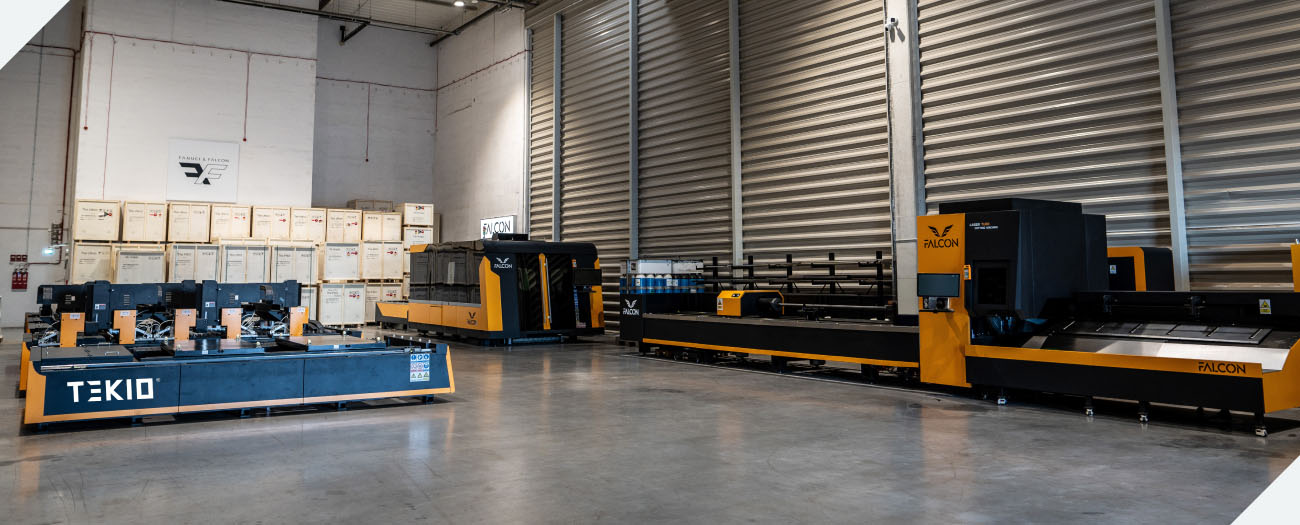
Professional laser cutting machines

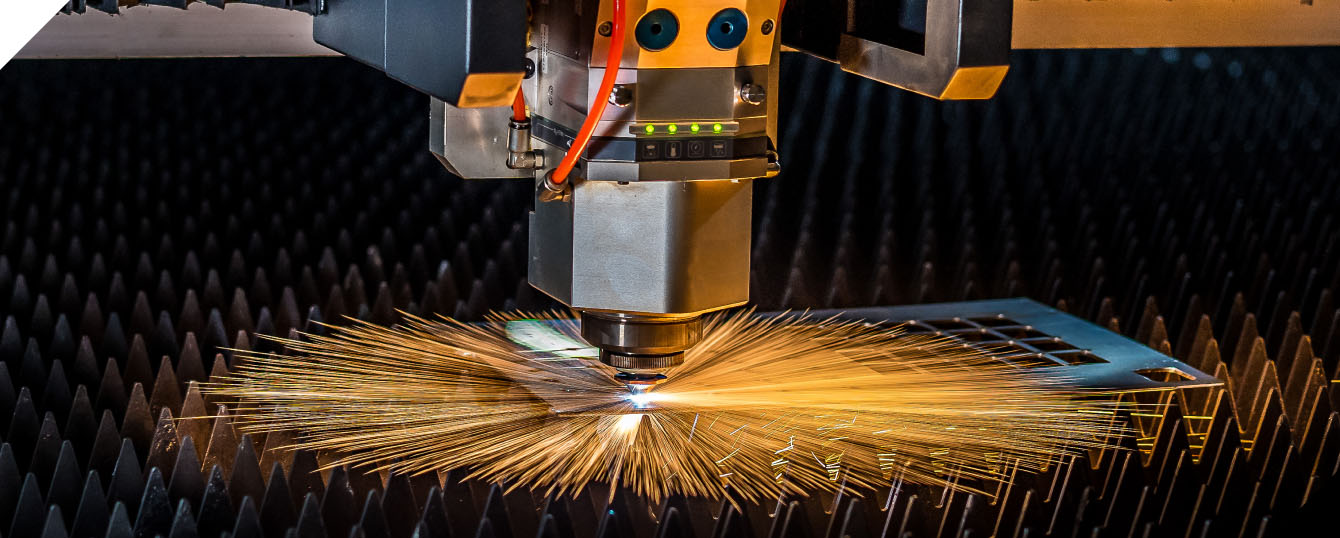
Accelerate your production processes while improving cut quality with modern machines using advanced fiber laser cutting technology. These systems combine high laser power, precision, and reliability to deliver outstanding results in metal fabrication.

1 000W - 12 000W
 
Fiber laser cutting machines for tubes and profiles – FALCON
FALCON T Masterline – a series of industrial fiber laser cutting machines designed for tubes and profiles. Advanced 2D/3D laser cutting solutions for demanding applications. Available laser power range: 1,000W – 12,000W. Learn more
2 000W - 24 000W
 
Fiber laser cutting machines for sheet metal – FALCON
FALCON S Masterline – a professional series of laser cutting machines for sheet metal processing. Industrial 2D/3D fiber lasers designed for high performance, precision, and reliability. Available power range: 2,000W – 24,000W. Learn more

Cost-optimized laser cutting machines

Optimize your production costs with an affordable solution that does not compromise on quality. These fiber laser cutting machines provide precise and efficient cutting, making them an excellent entry-level investment with strong performance.

1 000W - 12 000W
 
Fiber laser cutting machines for tubes and profiles – TEKIO
TEKIO T Compactline – one of the most competitively priced machines laser systems for tube and profile cutting worldwide. A small investment with significant production advantages. Industrial fiber laser cutting machines designed for efficiency and reliability. Available laser power: 1,000W – 12,000W.Learn more
2 000W - 24 000W
 
Fiber laser cutting machines for sheet metal – TEKIO
TEKIO S Compactline – a highly competitive range of laser cutting machines for sheet metal fabrication. Designed for businesses seeking cost-effective yet powerful equipment. Available power range: 2,000W – 24,000W.Learn more
 
 
logo falcon

WHY CHOOSE
FALCON LASER CUTTING MACHINES

Advanced fiber laser cutting technology allows you to handle more complex projects, increasing your company’s competitiveness and the overall quality of your services.

 
CNC machine center headquarters
 
 
  • Energy efficiency and lower operating costs

    Fiber laser cutting machines are unmatched in terms of efficiency. Compared to traditional technologies such as CO₂ or plasma, they consume significantly less energy and require fewer consumables. This leads to lower operating costs, improved productivity, and a reduced carbon footprint.

  • Adaptation to different production environments

    The compact design of modern laser cutting machines makes them easy to integrate into various production environments. Thanks to flexible configuration and customization options, these systems can be fully optimized to match your business needs.

  • Advanced technology

    It is difficult to stay competitive using outdated solutions. Fiber laser cutting machines significantly accelerate fabrication processes, offering superior performance and making your machine park more competitive in terms of both speed and cut quality.

  • High precision and accuracy

    Modern fiber lasers provide exceptional laser accuracy thanks to a focused beam and high energy density. This enables precise cutting of complex shapes and patterns while minimizing thermal distortion. The result is consistently high quality across all materials.

  • Outstanding productivity

    With high speed operation, fiber laser cutting machines dramatically increase productivity. Whether processing thin or thick sheet metal, these machines deliver significantly higher cutting speed than traditional methods, reducing both time and costs.

  • Versatility

    Fiber laser cutting machines are suitable for processing a wide range of materials, including steel, stainless steel, aluminum, copper, brass, as well as plastics and selected composites. Their versatility makes them ideal for diverse industrial applications, enabling businesses to complete complex projects with maximum precision and efficiency.


FAQ
– Frequently Asked Questions About Fiber Laser Cutting Machines

1. What makes fiber laser cutting machines different from CO₂ laser systems?

Fiber laser cutting machines offer higher efficiency, faster cutting speed, lower energy consumption, and better performance on reflective metals such as copper and brass, compared to traditional CO₂ laser systems.

2. What cutting speeds can fiber laser cutting machines achieve?

Fiber laser cutting machines can reach cutting speeds significantly faster than CO₂ systems, often exceeding 100 inches per minute, depending on material thickness and machine configuration.

3. What factors influence cutting speed?

The cutting speed depends on the type of material, its thickness, and the specific settings of the laser cutting machine, including laser power and process parameters.

4. Why are fiber laser cutting machines considered high-performance systems?

They are designed for rapid processing, enabling faster production cycles, improved productivity, and overall higher manufacturing efficiency.

5. What materials can fiber laser cutting machines process?

These machines can process a wide range of materials, including steel, stainless steel, aluminum, copper, brass, titanium, as well as non-metals such as acrylic, wood, MDF, leather, fabric, paper, rubber, and plastics.

6. Are fiber lasers suitable for reflective metals?

Yes, fiber lasers are highly effective on reflective metals like copper and brass, which are difficult to process with other laser technologies.

7. In which industries are fiber laser cutting machines used?

They are widely used in aerospace, automotive, medical device manufacturing, sheet metal fabrication, and general metal fabrication industries.

8. How precise are fiber laser cutting machines?

They deliver exceptional laser accuracy, often with beam quality close to M² ≈ 1, enabling highly precise cutting, fine detailing, and excellent repeatability.

9. What ensures high cut quality in fiber laser cutting?

Cut quality is ensured by CNC control systems, stable laser beam focus, and the use of assist gases such as nitrogen or oxygen, which remove molten material and reduce thermal distortion.

10. Do fiber laser cutting machines produce clean cuts?

Yes, they typically produce minimal kerf width and smooth edges, making them ideal for applications requiring high precision and clean finishing.

11. How efficient are fiber laser cutting machines?

They achieve energy conversion rates of approximately 30–50%, compared to only 10–15% for CO₂ lasers, making them significantly more energy-efficient.

12. Do fiber laser systems reduce operating costs?

Yes, they consume less energy and require fewer consumables, resulting in reduced waste and lower long-term operating costs.

13. How much maintenance do fiber laser cutting machines require?

They are designed for minimal maintenance, which increases reliability and ensures long-term stable operation in industrial environments.

14. What makes fiber laser cutting machines durable?

Their robust industrial construction allows them to withstand continuous operation, ensuring long-term durability and stable performance.

15. What maintenance is required for fiber laser cutting machines?

Basic maintenance includes lens cleaning, system inspection, and optical alignment to ensure consistent cut quality and machine longevity.

16. Can fiber laser cutting machines improve production efficiency?

Yes, their high speed and automation compatibility significantly increase production efficiency and reduce processing time.

17. Are fiber laser cutting machines suitable for different material thicknesses?

Yes, they can handle a wide range of material thickness, depending on laser power and machine configuration.

18. What role does CNC control play in fiber laser cutting?

CNC systems precisely control the cutting head movement, ensuring accurate path execution and high repeatability in cutting operations.

19. Are fiber laser cutting machines suitable for complex shapes?

Yes, their high precision and stable beam focus allow for cutting complex geometries with excellent accuracy.

20. Why are fiber laser cutting machines considered a modern industrial standard?

Because they combine high speed, precision, efficiency, low maintenance, and versatility across a wide range of materials and applications.

21. How fast are high-performance fiber laser cutting machines in real production conditions?

High-performance fiber laser cutting machines are designed for rapid processing and can achieve cutting speeds exceeding 100 inches per minute, depending on material thickness, laser power, and system configuration. This directly improves manufacturing efficiency and overall productivity.

22. Can fiber laser cutting machines process non-metal materials as well?

Yes, in addition to metals such as stainless steel, aluminum, copper, and titanium, some fiber laser cutting machines can also process non-metal materials like acrylic, wood, MDF, plastics, rubber, and fabrics, depending on the system setup and application.

23. How does beam quality affect cut precision in fiber laser cutting?

Fiber lasers typically achieve beam quality close to M² ≈ 1, which allows for a very small and stable focal spot. This results in extremely precise cutting, minimal kerf width, and superior cut quality, even in detailed or complex designs.

24. What maintenance practices are required to ensure long-term performance?

Although fiber laser cutting machines require minimal maintenance, regular practices such as lens cleaning, system inspection, and optical alignment are essential to maintain consistent performance, extend machine life, and ensure high cut quality over time.

SCHEDULE A FREE CONSULTATION WITH OUR EXPERT

Fill out the contact form to get in touch with our expert who will help you choose optimal laser solutions, perfectly tailored to your needs.

  • 1.Fill out the form
  • 2.We'll contact you back within 24 hours
  • 3.Our expert will select the best solutions for your business